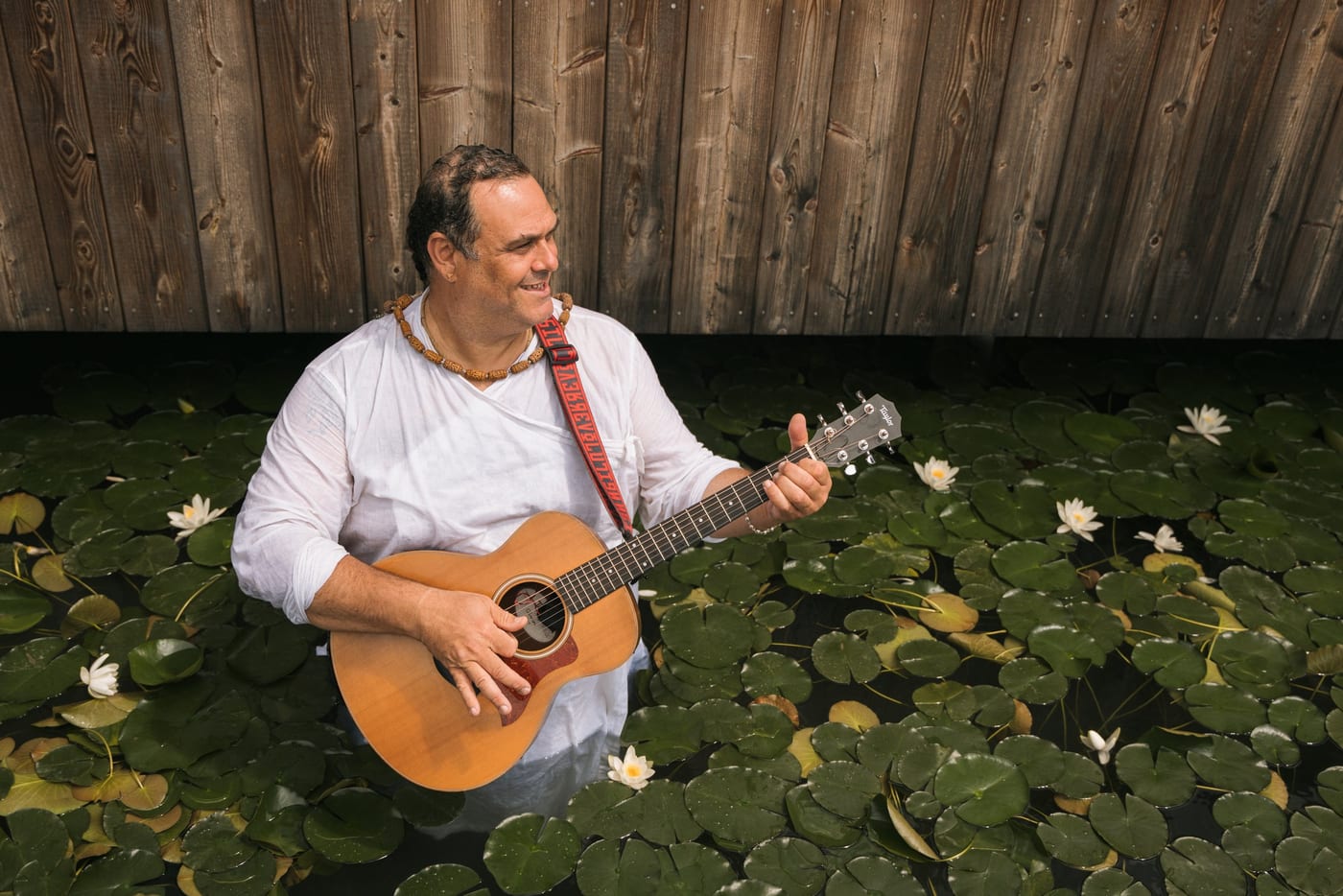

Gaura Vani is a kirtan artist, storyteller and singer who has spent two decades touring the world, sharing stages with Jai Uttal and Krishna Das. Raised by monks in temples from age four, he later acted in Hollywood films before returning to the music that shaped him. His catalog is large, but the entry point doesn't need to be.
Start with "Bhaja Govindam (We All Bleed Blood) [Live at Royal Opera House Mumbai]" (April 2026). It's one track, it's live, and it shows what he does best: take a Sanskrit devotional text, in this case the Bhaja Govindam, and pair it with a plain English idea that anyone can feel. The title's parenthetical tells you his approach. This is bhakti aimed at shared humanity, not a closed circle.
Listen to it once while doing nothing else. Then listen again with the lyrics open. A live recording also gives you the thing that matters most in kirtan: the call-and-response energy of a room.
"Wade in the Water - Royal Opera House, Mumbai (Live)" (January 2026). This is from the same venue, but it's a spiritual rooted in the American tradition, sung by a kirtan artist. It shows how comfortably he moves between East and West, which is central to his work and to collaborations like As Kindred Spirits.
"Dona Nobis Pacem" (2024). A Latin prayer for peace, rendered in his devotional style. If the first two tracks felt like concerts, this one is quieter and better suited to meditation.
"Krishna Kripa Ho Tabhi" (2024). Here you get the Hindi bhajan side of him, closer to traditional devotional singing. Move to this once the Sanskrit and English material feels familiar.
If you want the deeper catalog after that, his bio names the albums Ten Million Moons and Leaps and Bounds. I can't speak to their contents, so approach them as your next exploration rather than a guided stop.
Expect repetition. Kirtan works by returning to a phrase until the mind stops analyzing it. Expect harmonium and other instruments from the Indian tradition, with melodies that build gradually. Expect warmth and a storyteller's presence rather than virtuosic showmanship; he describes his music as an invitation for the heart to sing.
The live recordings will sound communal. That's intentional. You're hearing a participant as much as a performer, and you're invited to join in even if you're only humming in your kitchen.
"It's a performance, so I should just listen." Kirtan is designed for participation. Sing quietly along, even badly.
"I need to understand Sanskrit or Hindu theology first." You don't. His work translates feeling before it translates vocabulary, and tracks like "Wade in the Water" and "Dona Nobis Pacem" deliberately draw on traditions you may already know.
"It's religious, so it isn't for me." The devotion is real, and it centers on Krishna, but his material is hospitable to non-practitioners. Treat it as you would any sacred music from a tradition not your own: respectfully, with curiosity.
"The repetition means it's simple." Simplicity of structure is not simplicity of effect. The experience comes from staying with it past the point of boredom.
"He's only a kirtan singer." His background includes a monastic childhood, a teenage rebellion, acting work, band projects and ten produced albums. The music carries that range.
Kirtan tends to hit hardest during transitions: grief, burnout, a move, a breakup, a stretch when talking and thinking have stopped helping. It also suits people who have lost patience with silent meditation because their mind is too loud, since singing gives the mind something to do. If you grew up with a faith you drifted from, his story of rebellion and return may feel especially familiar. And if you're simply tired and craving community without small talk, a recording like the Mumbai live tracks can stand in until you find a local gathering.
Day 1: Listen to "Bhaja Govindam (We All Bleed Blood)" start to finish, no multitasking. Write down one line that stuck.
Day 2: Play it again with the lyrics, and sing along quietly for the repeated sections.
Day 3: "Wade in the Water" (live). Notice how the audience participation changes the feeling.
Day 4: "Dona Nobis Pacem," ten minutes before bed, lights low.
Day 5: "Krishna Kripa Ho Tabhi." Look up the meaning of the title and lyrics, then listen again.
Day 6: Revisit your favorite of the four and sing it aloud, at full voice if you can, alone in a room or on a walk.
Day 7: Listen to the 2026 single "Unlimited" as a look at where he is now, then decide: explore Ten Million Moons or Leaps and Bounds, or look for a live kirtan near you. His own invitation is to sing, so the week ends best with you doing exactly that.