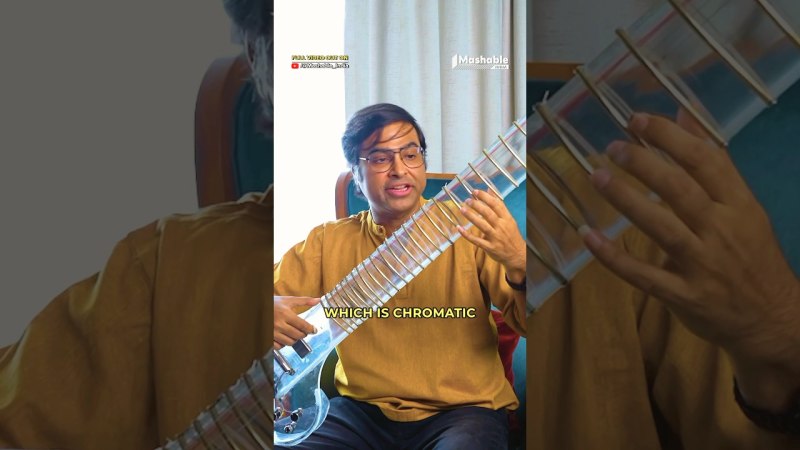
Purbayan Chatterjee is a sitar virtuoso who has built his career on a foundation of Hindustani classical music while consistently exploring the boundaries where raga meets contemporary sound. Rooted in the guru-shishya parampara—the traditional teacher-disciple lineage that remains the backbone of Indian classical training—Chatterjee performs repertoire spanning Raag Mishr Kafi, Raag Shyam Kalyan, Raga Bhairavi, and Raga Bageshree, alongside experimental collaborations that place the sitar in dialogue with jazz, rock, and world music idioms.
His approach to the sitar distinguishes itself through a willingness to move fluidly between concert hall tradition and studio experimentation. Where many classical sitarists focus exclusively on the purity of raga exposition, Chatterjee treats the instrument as equally at home in a jugalbandi with tabla or in layered studio arrangements with electric guitar and synthesizers. This dual identity has earned him invitations to perform at India's most respected classical music venues—including the Sawai Gandharva Bhimsen Mahotsav in Pune and Narad Gana Sabha in Chennai—while also opening doors to collaborative projects with musicians outside the Indian classical sphere.
His recorded work includes Sitar Stories (2024), Classicool, Milaap, Unbounded, and Antar - The Transformation. These albums document both his command of traditional raga performance and his interest in fusion formats that layer sitar over contemporary production. He has collaborated with guitarist Mark Lettieri on tracks including Feathered Creatures and 9000 Miles, and worked with mandolin virtuoso U Rajesh and a rotating ensemble of tabla and percussion artists. The projects range from strictly classical recitals to studio experiments that test how far the sitar's microtonal language can stretch without losing its core identity.
Chatterjee's training followed the guru-shishya model, the centuries-old system in which a disciple lives and learns in close proximity to a master. This lineage has shaped not only his technical facility but also his commitment to preserving the transmission system itself. He organizes UMANG, an annual event in Mumbai dedicated to celebrating the guru-shishya parampara and providing a platform for younger artists trained in this tradition. The event functions both as a concert series and a public affirmation of the pedagogical model that produced him.
His performances attract audiences across India's classical music circuit, and his streaming presence has introduced his work to listeners outside the traditional sabha system. He continues to tour nationally, performing both solo recitals and ensemble collaborations, and maintains an active recording schedule that balances classical releases with fusion projects.
Chatterjee's catalog is divided roughly between purist raga performances and collaborative albums that re-imagine the sitar's role in ensemble contexts. His classical concerts follow the traditional structure of alap, jor, jhala, and gat, often running two hours or more. His fusion projects compress that architecture into shorter, produced tracks that retain the melodic and rhythmic vocabulary of Hindustani music but add harmonic and textural layers drawn from other genres.
For listeners discovering his work today, Chatterjee offers a entry point into Hindustani classical music that does not require choosing between tradition and experiment—his catalog demonstrates that the same musician can honor the raga system's rigor while testing its adaptability to new contexts.