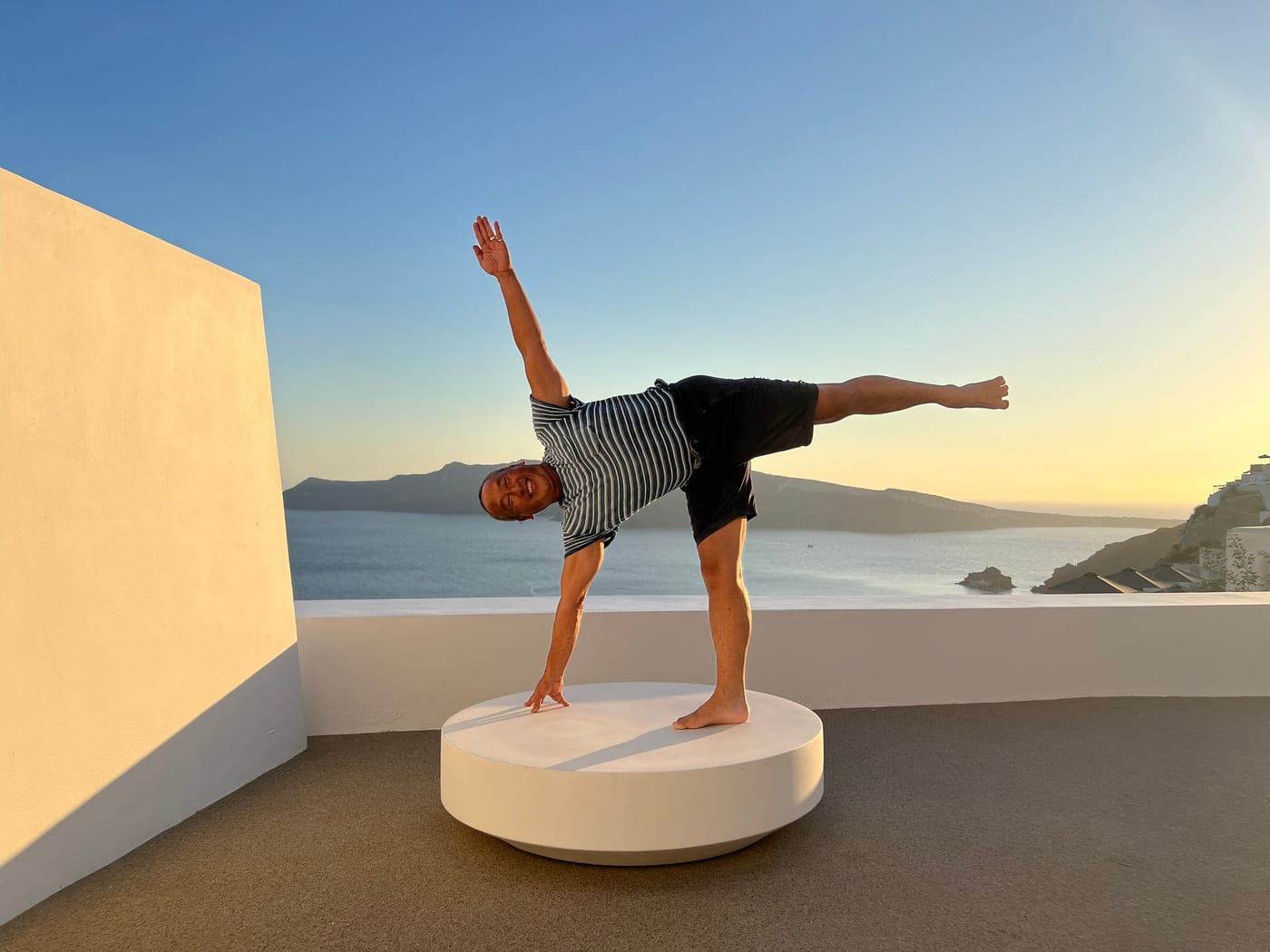

Rodney Yee has spent roughly forty years inside a single discipline, and he still talks about it as an open question. A yoga teacher grounded in the Iyengar tradition, he is known for a patient, curious approach to the human body and for an equally persistent interest in what lies beyond it: the mind, the emotions, and the more elusive territory of spirit. His stated commitment is to unearth deeper insights about the body and to offer yoga tools and mindful practices that help people find peace. That description is modest, but it points to something distinctive in his work. He is less a purveyor of answers than a long-term investigator who invites others to look alongside him.
Yee is an American-born Asian from California. The documented record of his early life is spare, and his hometown is not specified here, but the outline of his formation is clear. His pursuit of wholeness began in high school, in gymnastics, where the body is both instrument and teacher. From there he moved into the study of philosophy and physical therapy at the University of California, Davis, and the University of California, Berkeley. The pairing is telling: philosophy asks what a life is for, while physical therapy asks how a body actually works and heals. Both questions would later sit at the center of his teaching.
Yee left college to pursue dance. He performed with the Oakland Ballet Company and with the Matsuyama Dance Company of Tokyo, years that deepened his understanding of movement, discipline and physical expression. Yoga, which he began studying in the 1980s, became the synthesis of these threads. It offered the athletic rigor of gymnastics, the expressive precision of dance, the anatomical attention of physical therapy and the reflective depth of philosophy. Rather than abandoning his earlier pursuits, he found a practice that could hold all of them.
He grounded himself in Iyengar Yoga, a tradition known for exacting alignment and a methodical study of the body. He trained at The Yoga Room in Berkeley and at the Iyengar Institute of San Francisco, learning from teachers including Donald Moyer, Manouso Manos and Ramanand Patel. His early approach is described as practical and inquisitive, beginning with the intricacies of the body and widening over time to include mind and spirituality.
In 1987, Yee co-founded The Piedmont Yoga studio with Richard Rosen and Claire Finn. It was an early step in establishing yoga as a serious, community-based practice in the Bay Area, and it anchored his teaching in a physical place, with students and colleagues who could test ideas over time.
His public profile grew when he appeared in the Yoga Journal calendar in 1989 and 1991. That visibility led to a video career under Healing Arts, which later became part of the Gaiam Company. For many practitioners in the United States, home video was the first way into yoga, and Yee's instructional work reached people who might never have entered a studio. The specific titles of those videos are not detailed in the available record, but the pathway itself is significant: a teacher trained in a rigorous lineage translating that training for a broad, at-home audience.
Yee, together with Colleen Saidman, partnered with Donna Karan to establish UZIT LLC, associated with Urban Zen Integrative Therapy. The initiative brings together yoga, Reiki, essential oils and meditation. It reflects a long-standing theme in his work, the integration of body, mind and spirit, and shows his willingness to work alongside practitioners from other healing and wellness traditions rather than treating yoga as a closed system.
Since 2003, Yee has lived in Sag Harbor, New York, with his partner, Colleen Saidman. Together they have a blended family. The two teach at Colleen's studio, Yoga Shanti, and offer classes, workshops, retreats and teacher trainings around the world. Yee teaches in person and also by livestream, which extends his reach beyond any single room or region.
This chapter finds him in a different position than the one he held in the video era. The audience is no longer limited to what a disc or broadcast can carry; it includes students who join live from anywhere, and teachers-in-training who study with him and Saidman directly. The partnership is itself a kind of teaching, a long-running example of two practitioners sharing a life and a craft.
His digital footprint is modest. His music presence, such as it is, is small, with a few thousand followers on Spotify, a reminder that his work lives mainly in classrooms, studios and retreat settings rather than in the attention economy.
Yee's importance lies in several overlapping contributions.
First, he is a bridge between lineage and the general public. His Iyengar training gave him a foundation of precision and respect for form, and his video work and calendar appearances carried yoga to people who were new to it. Few teachers have managed both the depth of a traditional apprenticeship and the reach of mass media.
Second, he represents a cross-disciplinary path. Gymnastics, ballet, philosophy and physical therapy all feed his teaching. For students who come to yoga from athletics, dance, medicine or academic study, his biography suggests that earlier passions are not obstacles to be set aside but material to be integrated.
Third, he is a visible Asian American presence in a field that has often been presented through a narrow lens. As an American-born Asian from California, he is part of the story of how yoga took root in the United States, shaped by teachers who came from many backgrounds.
Finally, his emphasis on peace is practical rather than abstract. The tools he offers, including postures, breath, meditation and integrative therapies, are meant to be used. After four decades, he continues to describe the work as ongoing inquiry into the complexities of human experience, and that humility is perhaps the clearest sign of its seriousness.
Rodney Yee's story is not one of a single breakthrough but of sustained attention. From a gymnast's curiosity to the stage, from the studios of Berkeley to living rooms and livestreams, he has kept returning to the same questions about how the body works, how the mind follows, and how people might find some measure of peace. For the students who practice with him and the teachers he helps train, that long, steady inquiry is the legacy, and it is still unfolding.