Transcript
[0:00] The data that continues to come out gets
[0:02] worse and worse every week and it is way
[0:04] worse than you think. I know there's a
[0:06] lot of economists out there and housing
[0:08] experts who say things are going to be
[0:10] better. 2026 is going to get better. The
[0:12] reality is there's no chance that that's
[0:15] going to be happening, especially in
[0:16] Florida and across the United States.
[0:18] It's getting worse across the United
[0:20] States and it's spreading rapidly. the
[0:22] housing market is in trouble and we're
[0:25] going to be going over some of the data
[0:26] as why that is and what you can do to
[0:29] prepare now if you own a home or you're
[0:31] thinking about selling a home. So, the
[0:33] number one thing you want to realize is
[0:34] that this is the second lowest number of
[0:37] sales ever. This is a huge issue because
[0:40] we've had 20% population growth over the
[0:43] last few decades, but yet we're at the
[0:45] second lowest level of existing home
[0:48] sales that came out in July 2025.
[0:50] 388,000 existing home sales, the lowest
[0:53] sales since 1999.
[0:56] So, this is really bad. I know that
[0:59] people are saying, "Well, it's not as
[1:00] bad as the great financial crisis." And
[1:02] you're right, it's worse. We're already
[1:03] feeling this type of distress. And when
[1:06] the number of existing home sales start
[1:08] to slow down, that is the number one
[1:10] indicator that everything else is about
[1:12] to slow down as well, including price.
[1:14] So price drops are just waiting because
[1:17] the reality is you just have inventory
[1:18] stack and stack and stack up. As these
[1:21] home sales go down, sellers get
[1:23] frustrated, sellers start capitulating
[1:24] on their price. They start reducing
[1:26] their price and everything starts moving
[1:28] forward that way. So here's, you know,
[1:30] the nonseasonally adjusted home sales. I
[1:33] think it's a good representation of what
[1:34] happens. Of course, you could see where
[1:36] we are today and how how low we are now.
[1:39] It's not going to get fixed by Fed
[1:41] Powell reducing interest rates by 25
[1:44] basis points. That is not going to
[1:46] change overall how the consumer feels
[1:48] about housing or what is coming next for
[1:50] housing because we are ultimately in
[1:52] what's called an affordability crisis.
[1:55] It is really bad. When you look at the
[1:57] median household income versus what the
[2:00] median sales prices are, it just doesn't
[2:02] make sense for the average consumer to
[2:05] buy. In a lot of cases, it's cheaper to
[2:08] rent by about $500 a month. You don't
[2:10] have to worry about the repairs. And
[2:12] look at this. You can see this chart is
[2:14] fantastic from Visual Capitalist. You
[2:16] can see Florida gets a ranking of 0.52.
[2:18] That's one of the least affordable
[2:20] rankings out there. Um, you can also see
[2:22] that it's less affordable to live in
[2:24] Florida than it is in California, which
[2:25] is kind of mind-boggling, but this is
[2:27] from a median household income
[2:29] perspective. You can see that it's
[2:30] starting to go across the United States.
[2:32] Even we're starting to see affordability
[2:34] issues pop up in the Northeast where
[2:36] we've seen some resilience. Now we're
[2:38] starting to see it get weaker and weaker
[2:40] and it's just a common sense thing now
[2:42] that we can see look there's going to be
[2:44] epicenters like Florida and Texas,
[2:46] Arizona, now Nevada, California,
[2:48] Colorado. These are areas that are super
[2:50] unaffordable and are getting more
[2:52] challenging to do real estate business
[2:53] in. But it's going to spread across the
[2:56] United States over a period of time. So
[2:58] again, I think that we don't need
[3:00] interest rates to come down. We need
[3:02] prices to come down. That's the way we
[3:04] reset the system and let the next
[3:06] generation of home buyers actually be
[3:08] able to tap into buying real estate.
[3:10] That's how you get a healthy market. It
[3:12] is not by reducing the Fed funds rate,
[3:14] which actually, by the way, could
[3:15] actually raise interest rates because it
[3:17] could stoke inflation fears because the
[3:19] Fed only controls the short term
[3:21] overnight borrowing rates of banks.
[3:23] Okay? Unless the Fed's going to go and
[3:25] do quantitative easing and start buying
[3:26] mortgage back securities, which they've
[3:29] done in the past, trillions of dollars
[3:30] worth, it's possible that, you know, we
[3:33] we could see that happen. It's very
[3:35] unlikely to happen unless we're in an
[3:37] absolute crisis mode, but next year
[3:39] probably not going to happen, but
[3:41] reducing rates is not going to be enough
[3:43] to save the housing market moving
[3:45] forward. Now, the income you need to buy
[3:47] a house, look at this, it's about
[3:49] $120,000.
[3:50] Plus, the median household income in
[3:52] Jacksonville is 68,000. So, you have to
[3:55] have a dual income working family if you
[3:56] live here to be able to purchase or you
[3:59] already have to be wealthy and have
[4:01] assets and have this level of income in
[4:03] order to be able to purchase here
[4:05] locally. And Jacksonville, Florida used
[4:06] to be specifically a very affordable
[4:09] place. That's actually why I moved here.
[4:11] And then, as you can see, over time,
[4:12] it's just become like ridiculously
[4:14] unaffordable. So, the income required to
[4:16] keep home payments affordable is just
[4:18] with a 20% down payment. And by the way,
[4:20] we have a lending company. We do not see
[4:22] people have 20% down payments. The
[4:25] people who could afford to buy, who had
[4:27] the good credit scores, who had the
[4:29] income, they've already purchased about
[4:31] 80% of them. So now you have this
[4:33] massive wave of sellers coming on over,
[4:35] you know, fighting over this 20% that
[4:38] didn't buy yet. And those are very
[4:39] educated people. They're going to be
[4:41] negotiating with you. So again, we think
[4:43] that prices will come down and um income
[4:46] to buy a house is out of control. We
[4:48] need to see wages go up and we need to
[4:50] see prices come down to get into more of
[4:52] an equilibrium. This is a crazy chart.
[4:54] New houses are now cheaper than existing
[4:57] homes. This is a massive red flag. This
[5:00] actually uh only happened one other
[5:02] time. You can see here in 2005, you
[5:05] know, right before the crash, this type
[5:07] of experience happened also. So, not
[5:09] only are the new homes less expensive
[5:12] now, but they're also offering on
[5:13] average 4050 $60,000 worth of incentives
[5:17] and rate buyowns. And so, we think the
[5:19] existing home inventory will start
[5:21] falling. We know that new home sales
[5:22] inventory prices are falling. And the
[5:24] incentives that the builders are giving
[5:26] are just absolutely incredible. But this
[5:29] this, you know, inflection point here is
[5:32] a huge red flag for the housing market.
[5:35] And we think that this could continue.
[5:37] We think that the prices are simply just
[5:38] going to have to come down both across
[5:40] the board between existing homes and new
[5:42] homes. Regardless of where you are, but
[5:44] especially in areas that are that are
[5:45] overbuilt and they've overbuilt across
[5:48] the United States, the home builders,
[5:50] the national home builders across the
[5:52] United States, they got addicted to the
[5:54] easy money, the fast sales, and they
[5:56] again, they did it again. They
[5:57] overbuilt. Uh it's just human nature
[5:59] that that this happens. So, here's LAR,
[6:03] which is a very difficult uh company to
[6:05] work with if you're a real estate agent.
[6:06] First they tried to cut out the real
[6:07] estate agent. Now they're begging real
[6:09] estate agents to come back and bring
[6:11] buyers to their brand, even offering
[6:12] incentives on top of the 3% commission
[6:15] the agents get. They actually sometimes
[6:16] offer five, six, seven. I've seen even
[6:18] 10 times uh 10% commissions depending on
[6:21] how many you sell in the community. But
[6:24] the this is LAR's average selling price
[6:26] net of incentives. It's dropped, look at
[6:29] this, 2022 from 483,000 all the way down
[6:33] to 389,000. We're talking almost
[6:36] $100,000 just within 3 years. That is
[6:38] significant amount of drop and it
[6:41] frankly could drop another h 100,000
[6:43] here. Locally, we see some of the
[6:45] builders are dropping their inventory
[6:47] price by $100,000 and offering the
[6:50] incentives. So, if you're a buyer out
[6:52] there looking to buy, the only problem
[6:54] that you have is if you get that rate
[6:56] buy down to 3 to 4%, you would have to
[6:59] stay in that house for basically 30
[7:01] years because that incentive is built
[7:03] into your rate. And you would have to
[7:05] stay there an extremely long period of
[7:07] time to be able to see that actual
[7:09] benefit come to fruition. Because if you
[7:11] go to sell in year 10, chances are that
[7:14] you won't have made up the difference.
[7:15] It's sometimes better actually to take a
[7:17] lower price than it is to get the
[7:19] incentives on the rates depending on the
[7:21] time frame that you're going to be
[7:23] living in the house. But ultimately, the
[7:24] builders are screaming from the
[7:26] rooftops, "We need help." They're going
[7:27] to the administration saying, "We need
[7:29] help. We need to keep pushing, you know,
[7:32] pushing our inventory," which is super
[7:33] ironic because they told us the entire
[7:35] time, the media that there's this
[7:37] housing shortage. How can there be a
[7:39] housing shortage when all the builders
[7:41] are screaming fire already and it's only
[7:43] been a few years? There is no housing
[7:45] shortage. What there is is there's an
[7:46] affordability shortage. There's a
[7:48] there's not affordable houses. They're
[7:50] not built. Look at the price points
[7:52] they're building these in, right?
[7:53] $500,000 house. That's not what
[7:57] consumers can afford right now when they
[7:59] make only 60 $70,000 a year, right? And
[8:02] even that's pretty good for a household
[8:03] income. They can they can afford usually
[8:05] in the $200 to $300,000 price point. So,
[8:07] I really think again we have an
[8:09] affordability crisis. We don't have uh
[8:12] an under supply crisis here. We
[8:14] obviously it's the opposite when you see
[8:15] inventory just start to stack up. This
[8:18] is the highest inventory that we've had
[8:20] of new single family homes for sale
[8:22] since October 2007. So I know people say
[8:25] it can't happen again. It can't happen
[8:26] again. Of course it can happen again.
[8:28] Actually it's happening again right now
[8:29] in the FHA world which is the government
[8:32] just continues to create programs to
[8:36] extend and delay losses in the housing
[8:38] market propping up the entire market. I
[8:40] mean, FHA, you can do loan loss
[8:42] mitigation um workouts and basically add
[8:45] your payments to the back end of the
[8:47] mortgage and it's a huge problem. It's
[8:49] keeping properties that should have been
[8:51] coming on the market in distress from
[8:53] coming onto the market, pushing prices
[8:55] absolutely continued up. And they've
[8:57] been doing this all the way back since
[8:59] 2020. And they came up with these
[9:01] programs to keep people in their houses.
[9:03] And we have not had a normal
[9:05] unmanipulated housing market for a very
[9:08] long time. And if you did, if the
[9:10] government wasn't buying these mortgage
[9:12] back securities or having these workout
[9:13] programs to keep people in their houses,
[9:16] we would be seeing a completely
[9:17] different market here today that would
[9:19] be pretty much double as worse of what
[9:21] we're seeing right now already when
[9:23] we're not even seeing distress and we're
[9:24] seeing assets near all-time highs when
[9:26] we think about the stock market,
[9:28] Bitcoin, and other asset classes. So,
[9:30] look, our expectation is that real
[9:32] estate is seasonal and we think that the
[9:35] going into the end of the year and going
[9:37] into early next year, we're going to see
[9:40] inventory continue to stack. We're going
[9:43] to see prices come down across the
[9:45] board. We think it's going to hit the
[9:47] majority of the markets across the
[9:48] United States, and it's going to get
[9:50] worse from here on out going into next
[9:53] year. And next year, we're going to see
[9:54] this wave of foreclosures because
[9:56] October 1st, these FHA and VA workouts
[9:59] are no longer going to be allowed. It's
[10:01] going to be much more difficult and
[10:02] we're going to finally see the
[10:03] foreclosures backlog start to hit the
[10:06] markets moving forward. So, here's the
[10:09] reality. Prices are already starting to
[10:10] drop. So, again, I still don't
[10:12] understand why we see a lot of housing
[10:13] experts and economists come out and say,
[10:15] "Oh, everything's fine. It's getting
[10:16] worse every single month." Home prices
[10:18] fell on a record 39 major US metros in
[10:21] July. And you can see that that was, you
[10:24] know, that's the worst it's been in
[10:26] basically a decade. And we expect this
[10:28] to continue to move up and move uh move
[10:31] prices down, you know, as as headlines
[10:33] start to come out. What's really
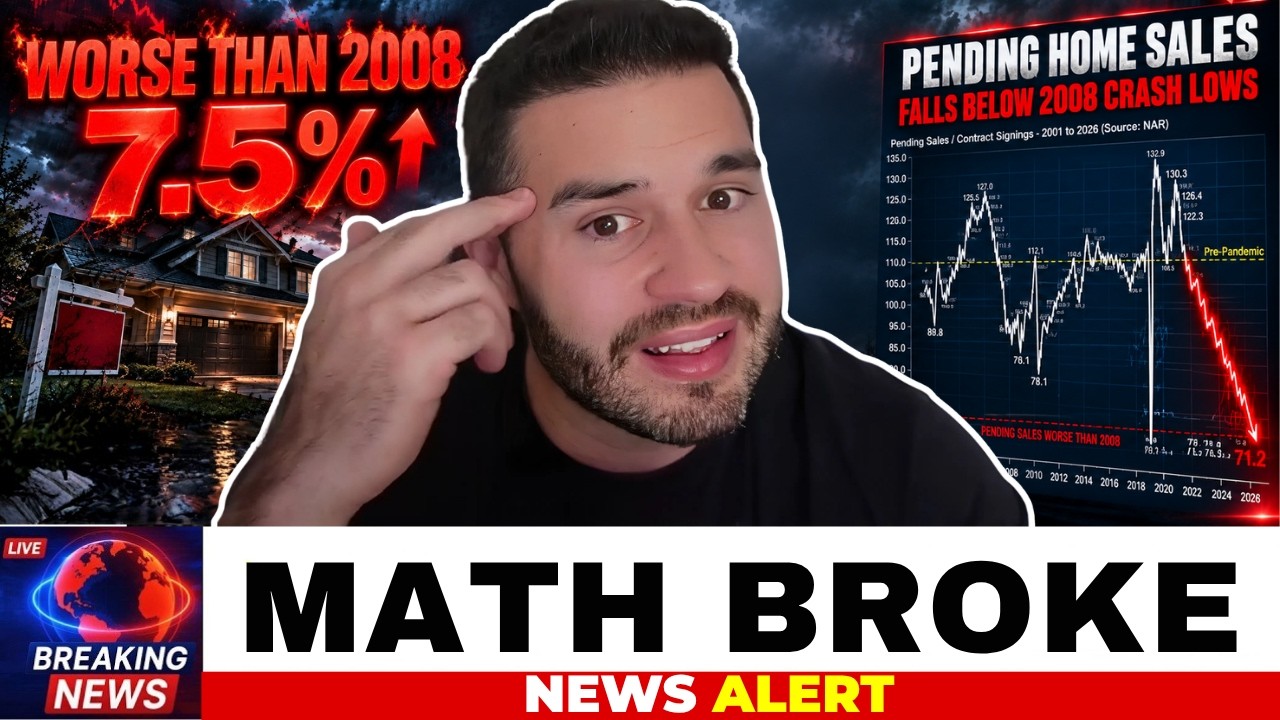
[10:34] concerning is the pending home sales.
[10:36] Home sales are just grinding around
[10:38] along the bottom there, and we expect
[10:40] them to actually go a little bit lower.
[10:42] It's felt really awkward if you're a
[10:44] real estate agent or if you're looking
[10:46] to even sell your house, if your house
[10:47] is not in mint condition. And I will say
[10:49] this, there are pockets of areas that
[10:51] are very unique, like Jacksonville
[10:53] Beach, let's say, for example, or
[10:55] Neptune Beach, where there's a limited
[10:57] supply of inventory, the housing is
[10:59] beautiful, it has ocean views, and
[11:01] there's really not a lot of inventory to
[11:04] compete with. Those type of areas are
[11:06] going to keep up a little bit better,
[11:07] but they will eventually get hit. But
[11:09] the problem is across the board, the
[11:11] pending home sales coming down this
[11:13] much, the inventory is going to stack
[11:15] and we expect it to be a challenge
[11:17] moving forward through the end of the
[11:18] year. Of course, if you're a real estate
[11:19] agent, you feel this. You're starting to
[11:21] see it every single day. Maybe you've
[11:23] had your head in the sand for the past
[11:25] few years and just ignored what's been
[11:27] happening since 2022. But if you haven't
[11:30] change your business soon, your business
[11:32] model and what you're spending and how
[11:33] you're doing business, then you could be
[11:35] in real trouble starting now. Basically,
[11:38] I we're starting to see a lot of
[11:39] distress amongst real estate agents and
[11:41] able to sell the properties that they're
[11:43] listing. Now, this is where new home
[11:45] prices are dropping the fastest. Okay.
[11:48] So, obviously, we're seeing Little Rock,
[11:50] Austin, Witchah, Jacksonville,
[11:52] Jacksonville is where I'm at. We
[11:54] definitely see prices coming down 7.81%.
[11:57] It's it's about double that in reality
[11:58] from this chart. Um, this comes from
[12:00] realtor.com. Cape Coral, another Florida
[12:02] location. Colorado Springs for sure.
[12:05] California, Virginia, um Tulsa,
[12:08] Nashville. So, we are starting to see
[12:10] these new home prices come down pretty
[12:12] significantly across the board and the
[12:15] unaffordable areas are getting hit the
[12:16] hardest. The areas where they built the
[12:18] most, where there was the most
[12:19] speculation, and frankly, there's a lot
[12:21] of tourism, right? The Airbnb markets
[12:23] and the speculators moved in to try to
[12:25] make as much money as possible, and
[12:27] they're getting crushed. I'm really
[12:29] excited. I have a guest coming on about
[12:31] the Airbnb market to tell you
[12:33] everything, the insides out of what is
[12:35] going on inside of the Airbnb across
[12:37] Florida and across the United States,
[12:39] what they're seeing on the ground with
[12:41] data. Be on the lookout for that. But it
[12:43] is a bloodbath to say the least in terms
[12:46] of what they're paying for maintenance
[12:49] and, you know, to run their Airbnbs
[12:52] versus, you know, the insurance and
[12:53] everything like that versus what they're
[12:54] getting. Especially when you see the
[12:56] occupancy drop so significantly, it
[12:59] really impacts your market. And so I
[13:01] think Jacksonville is in for a crash. I
[13:03] know so a lot of people disagree on
[13:05] this. You can think what you want, but
[13:06] the data is all pointing towards a
[13:08] crash. I don't see a way around it. A
[13:10] crash is a technical 30% drop from the
[13:12] peak. Okay? So we peaked in October of
[13:15] 2022 here in Jacksonville, and we're
[13:17] already down about 15%. So we're in a
[13:19] technical correction. And I know nobody
[13:21] wants to talk about it because it's not
[13:23] good for business, some people say, but
[13:24] you have to be real on what's going on.
[13:26] You need to be able to communicate it to
[13:28] to your sellers. And be real because you
[13:31] need to adjust your business plan. You
[13:33] need to participate in the market. You
[13:34] can't just pretend things are not going
[13:37] well and uh you know, expect that
[13:38] reality is not going to catch up with
[13:40] you. You need to get real on what the
[13:43] prices are doing and then adjust as much
[13:44] as possible. And sellers need to be
[13:46] realistic about the price of their home.
[13:48] I mean, if your house is outdated and
[13:50] there's 10 other houses in your
[13:52] community for sale, I mean, you need to
[13:53] get real. You have to drop that price
[13:55] really significantly to get a buyer. And
[13:56] the good news is because it's an
[13:58] affordability crisis, if you drop it to
[14:01] the price where you know buyers will be
[14:04] interested, you will get three or four
[14:06] offers right there on the spot. We see
[14:08] that happen all the time. Once the price
[14:10] hits where the market will accept it,
[14:12] you will get multiple bids. Again,
[14:15] because it's an affordability crisis,
[14:16] it's not that the demand is not there.
[14:18] the demand is there. It's just so
[14:19] expensive for people that they're
[14:21] doubling and tripling up living in
[14:22] apartments together, living in sun
[14:24] rooms, you know, moving back in with
[14:26] their parents, things like this, just
[14:28] because the prices are so crazy. So, I
[14:30] think it's a really good thing that
[14:31] prices are moving down. The one thing
[14:34] that is not being talked about enough is
[14:37] this natural population growth is
[14:39] horrendous. This natural increase in
[14:42] births minus deaths. You can see this in
[14:44] the United States versus the
[14:45] immigration. And I mean the immigration
[14:47] was insane. I mean open borders was just
[14:49] out of control, right? But we're not
[14:51] having enough people in the United
[14:53] States have kids and have household
[14:54] formation. And this is really bad for
[14:57] housing. And what we're seeing is people
[14:59] are are starting to it's because it's
[15:00] like too expensive to buy house. It's
[15:02] too expensive to get, you know, student
[15:04] loans, things like this. It is not the
[15:06] same as it used to be when you look at
[15:08] the ratios. And frankly, what's going to
[15:11] make it worse is that 5,000, it's
[15:13] estimated between 5 to 6,000 boomers per
[15:16] day were start passing away between now
[15:20] and 2035.
[15:22] And they all they have the majority of
[15:24] the wealth in real estate. So, let's
[15:25] look into this. You can see that the
[15:27] boomers are this uh this segment right
[15:29] here, and they own the majority of of
[15:32] real estate. And then you have Gen X and
[15:34] Millennial and the silent generation. So
[15:36] this trillions of dollars will be passed
[15:38] down or evaporated into basically
[15:41] retirement communities or assisted
[15:43] living facilities. And these these folks
[15:45] are passing away. Their inventory they
[15:47] own in some case these boomers own four
[15:50] houses 3 2 1 and they're starting to
[15:52] sell their rental properties and things
[15:54] like that. Them passing away means that
[15:56] you know 70% of these houses when
[15:59] somebody dies are are sold. They're not
[16:01] kept within the family. And this
[16:02] demographic shift is going to be insane.
[16:05] So we have a lack of births and then we
[16:07] have more deaths of just this generation
[16:09] that are going to push housing downward
[16:12] long term. So I don't think we're going
[16:14] to have we have this housing shortage
[16:16] that you know all this news and media
[16:18] are talking about. I think it's actually
[16:19] the opposite and I think it's going to
[16:20] get really painful to own real estate
[16:22] long term. Um if this continues to be
[16:25] the trend now of course there will
[16:26] always be intervention by the government
[16:28] if things go too haywire. So this is to
[16:30] hedge that by saying if the without
[16:32] government intervention I think that we
[16:34] can see a real downturn here that's
[16:35] worse than the great financial crisis
[16:40] and the leading indicators are negative.
[16:41] This is from Charles Schwab Bloomberg uh
[16:44] just you know a week or two ago but
[16:46] there's basically people are not feeling
[16:49] positive about the economy. things are
[16:51] really expensive and people are starting
[16:54] to experience job loss. And so we are at
[16:56] basically a low level that we were in
[16:58] 2009 and it doesn't even feel like we've
[17:00] been hit yet at all with any struggle
[17:03] and stress just because the stock
[17:05] market's kept up and actually risen so
[17:08] much. So we think, you know, this is an
[17:10] outlook that's really negative. We think
[17:11] that AI companies are going to continue
[17:13] to crush it as they replace employees.
[17:15] But the real economy is going to get,
[17:18] you know, absolutely decimated here
[17:20] because if you're talking to the average
[17:22] person, they are not doing so well
[17:23] financially and that's going to impact
[17:25] the housing market and their ability to
[17:27] purchase. Now, Florida is definitely the
[17:29] canary in the coal mine. We are probably
[17:30] the worst set up for this, especially
[17:32] for the deaths. We have about 22% of our
[17:35] population is our boomers are older
[17:38] which is a large it's a significant
[17:40] amount of the population but you can see
[17:42] here's the 10 slowest housing markets in
[17:44] the United States from realtor.com you
[17:46] know Miami or Orlando's getting
[17:48] absolutely crushed because they really
[17:50] overbuilt that area Jacksonville Florida
[17:52] Tampa Florida and then other hot spots
[17:54] like Raleigh that was a tech hub we saw
[17:56] a lot of growth there and now it's
[17:57] actually moving backwards. Um Nashville
[18:00] Tennessee is number one which is wild.
[18:02] So, we're probably going to see a little
[18:04] bit more of a slowdown. So, this is
[18:05] actually going back to a normal number
[18:07] that, you know, when I was selling real
[18:09] estate from 2016 to 2019, it wasn't
[18:12] unusual to have a house on the market
[18:13] for 60, 90, 120 days. So, we're just
[18:16] going back into a normal environment.
[18:18] It's just happening very quickly.
[18:20] Usually, real estate does not correct
[18:22] this quickly. It's a very slow step
[18:25] every single month. Uh, this is moving
[18:27] really, really rapidly and basically
[18:29] like doubling very quickly. Now, this is
[18:31] the home values that dropped. So,
[18:33] markets with the biggest drop in home
[18:35] values over the last year. 13 in
[18:37] Florida, two in Texas, and one Arizona.
[18:39] So, you can see that home prices are
[18:41] coming down, which again is a good thing
[18:43] for if you're a home buyer, but we need
[18:45] to see prices come down quite
[18:46] significantly more based on what we're
[18:48] seeing to get buyers back to the table
[18:50] and start having transactions. We'd love
[18:52] to see what you see in your
[18:54] neighborhood. Are you seeing more for
[18:55] sale signs? What's happening in your
[18:57] market specifically? As always, please
[18:59] subscribe and like and comment.
[19:01] Definitely helps out the channel. If you
[19:02] want to get more information that I
[19:04] can't talk about on YouTube, go down
[19:06] below and subscribe to my Substack
[19:09] newsletter. You'll get a notification
[19:10] every single time I put a video out.
[19:12] Love hanging out with you guys. Thanks
[19:13] for your comments and feedback on my
[19:15] channel. Pakistan.