In a studio or concert hall anywhere on Earth, someone begins to chant: "Om Namah Shivaya"—salutations to Shiva, the cosmic consciousness that underlies all form. Others join in, their voices layering over a simple harmonic framework that repeats and evolves. Within minutes, the boundary between singer and listener dissolves. The individual vanishes into the collective sound. This is kirtan: perhaps the oldest and most direct form of communal spiritual practice in Hindu and yogic traditions, and one experiencing genuine renaissance in the contemporary conscious music landscape.
Kirtan—a Sanskrit term meaning "to sing" or "to praise"—refers to the call-and-response chanting of sacred mantras, names of the divine, and devotional texts, typically accompanied by simple melodic refrains, hand percussion, and Indian instruments like the harmonium. Unlike classical Indian music, which prizes virtuosity within a rigorous raag framework, kirtan prioritizes accessibility, heart-centered intention, and the collective resonance of unified voices around a single spiritual focus.
The practice is ancient. Yogic texts and Hindu philosophy have documented kirtan for thousands of years as a direct means of accessing profound states of consciousness and connecting with the divine through the power of sound. In the Kashmir Shaivism tradition, for instance, mantra is understood not as mere words but as the crystallized form of divine consciousness itself—vibration that, when properly invoked, awakens dormant spiritual capacities within the practitioner. Kirtan democratizes this: it requires no prior training, no mastery of complex raags, no expensive instruments. It asks only for sincere participation and an open heart.
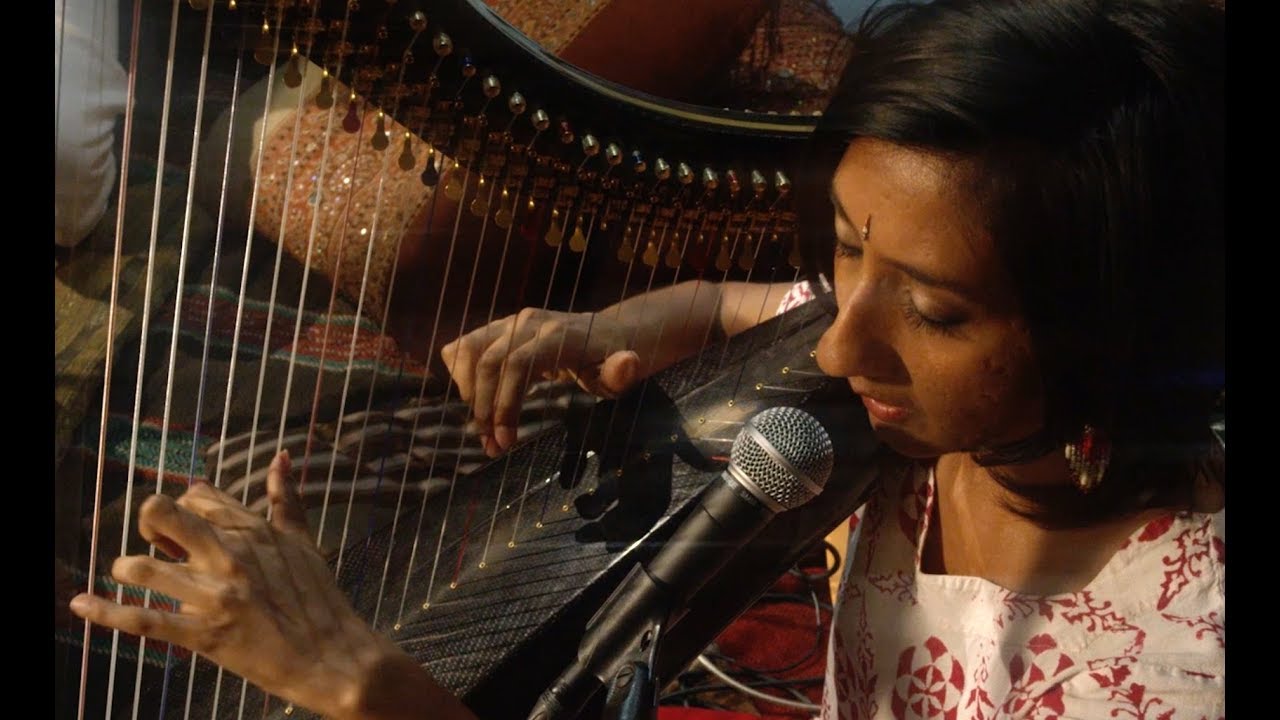
Sheela Bringi's "Shakti Sutra" unfolds as a fifty-five-minute journey through nine distinct mantras and their associated ragas, each one invoking a different aspect of the divine and a different frequency of consciousness. The progression itself carries meaning.
The session opens with "Namah Shivaya," one of the most revered mantras in Hindu philosophy. Shiva represents pure consciousness—witness consciousness, the unchanging awareness that underlies all phenomena. To chant "Namah Shivaya" (literally, "salutations to Shiva") is to bow to that principle of transcendent awareness within oneself and all beings. This is the foundation: consciousness itself.
From this grounding in pure awareness, the journey moves through "Peace Mantras"—invocations designed to still the mind and create inner sanctuary. Peace, in yogic understanding, is not merely the absence of conflict but the presence of sattvic (pure, harmonious) consciousness. These mantras prepare the ground for deeper work.
Then comes "Ya Devi"—an invocation of the divine feminine, the Goddess in her many forms. In Hindu philosophy, Devi represents Shakti, the dynamic creative force of the universe. Where Shiva is consciousness itself, Devi is the power that manifests, animates, and transforms. To invoke Devi is to acknowledge and awaken the creative, generative principle within and around us. This is why the video itself is titled "Shakti Sutra"—the thread of that divine feminine power woven throughout.
The subsequent mantras—"Krishna Govinda," "Ganesha Sharanam," "Sita Ram," "Shri Krishna," and "Chamundayai"—each invoke different deities representing different qualities of consciousness and different aspects of the spiritual path. Krishna embodies divine love and the joy of transcendent play. Ganesha, the remover of obstacles, represents the power to dissolve barriers on the spiritual journey. Sita Ram invoke the divine couple as principles of devotion and dharma (righteous living). Chamundayai represents the fierce, protective, transformative feminine power that destroys ego and ignorance.
The session concludes with an "Invocation" and "Guru Mantra"—paying homage to the lineage of teachers and the principle of transmission itself. In Hindu and yogic traditions, the guru is not a personality cult but a principle: the principle of wisdom transmitted from teacher to student, from consciousness to consciousness, across generations and centuries.
The title "Shakti Sutra" encodes both philosophy and practice. Shakti, in Hindu metaphysics, refers to the divine feminine principle—not a literal female form, but the dynamic, creative, vital, generative force of the universe. In Tantra and Kashmir Shaivism, Shakti is the active power through which consciousness manifests. Without Shakti, Shiva remains dormant, potential, unmanifest. Shakti is the thread, the stream, the movement.
Sutra means "thread" or "aphorism"—a concentrated teaching woven into language as simply as a thread passes through cloth. Collectively, a sutra is a continuous strand connecting discrete moments. "Shakti Sutra," then, is precisely what the video delivers: a threading of divine feminine creative power through sound, through these nine mantras, creating a coherent spiritual experience even as each mantra invokes a different deity and different quality of consciousness.
This is not new philosophy. It is ancient practice adapted for a contemporary moment. The sutra format—threading together related teachings or practices into a coherent whole—appears throughout Hindu and Buddhist scriptures. What Sheela Bringi does here is apply that same logic to kirtan: weave together mantras dedicated to different deities in a sequence that creates a journey, a story, a teaching.
Classical Indian music is organized around raags—melodic frameworks that define which notes are permissible, in what order they can be played, which notes should be emphasized, and how the melody should move through the scale. Each raag is associated with a specific time of day, season, or emotional state. Raag Yaman, for instance, is traditionally performed in the evening and carries qualities of contemplation and longing. Raag Bhairav, played in early morning, evokes spiritual awakening and devotion.
By incorporating raga into kirtan, musicians create a bridge between the ancient classical tradition and the contemporary devotional practice. Raga provides a sophisticated harmonic and melodic container that is still simple enough for participants without musical training to follow and join. The raga's repetitive, cyclical nature—where the same melodic patterns recur and deepen—mirrors the way mantra works: through repetition, through the grooves worn deeper with each cycle, consciousness begins to shift.
The "soulful rhythms" referenced in the video's title speak to this integration. Kirtan is not rhythmically complex in the way Indian classical percussion can be—there is no tabla wizardry here. Instead, the rhythm is elemental: a heartbeat, a pulse, something the body can entrain to immediately. This accessibility is intentional. Kirtan's power comes not from intellectual complexity but from the cumulative effect of many voices, many hearts, resonating together around a single intention.
In Hindu philosophy, mantra is not poetry or mere words. The Upanishads describe mantra as a crystallized form of divine consciousness itself—consciousness that has taken on the form of sound vibration. To chant a mantra is not to recite words in the hopes that some external deity will hear and grant a wish. Rather, it is to invoke, through the vibration of that specific sound, the principle the mantra names.
When you chant "Namah Shivaya," you are not asking Shiva to show up. You are, through the act of chanting, activating the principle of pure consciousness within your own being. The mantra and the consciousness it names are not separate. To invoke the mantra is to invoke that consciousness, to attune yourself to that frequency.
This is why mantras have specific syllables, specific sounds, specific orders. In Sanskrit, each sound is understood to have particular effects on the subtle nervous system and on consciousness itself. The "om" sound, for instance, is said to contain the vibration of all creation. The "ah" sound opens the heart. The "m" sound in "Namah" resonates with the crown of the head. These are not superstitions but observations about how sound, vibration, and consciousness interact—observations that contemporary neuroscience on sound healing is beginning to validate.
Over the past two decades, kirtan has experienced genuine revival and adaptation. What was once primarily a practice within Hindu temples and ashrams has spread into yoga studios, meditation centers, concert venues, and secular spiritual communities worldwide. This expansion raises questions: What is lost or gained when an ancient devotional practice encounters a contemporary audience often unfamiliar with Hindu theology? How does kirtan function when stripped of its original religious context?
One answer: the practice becomes more universal, more accessible, while also losing some specificity. Someone who chants "Namah Shivaya" in a yoga studio in Brooklyn may not believe in Shiva as a deity, may not practice Hinduism, may not even be religious at all. Yet they are still participating in a practice that has the power to quiet the mind, to align consciousness with sacred sound, to create collective resonance. The mantra works not because one believes in its theology but because the vibration itself carries transformative power.
This accessibility is perhaps kirtan's greatest gift to the contemporary world. In an era of fragmentation, information overload, and constant conceptual chatter, kirtan offers something simple and direct: a way to silence thought, to move from the thinking mind into the feeling heart, to remember one's unity with others and with something larger than the individual self. No belief required. Only participation.
If this exploration of kirtan, mantra, and shakti has opened curiosity, the next step is simple: listen. Seek out a kirtan session—whether recorded or live, whether rooted in Hindu practice or adapted for contemporary spiritual community. Listen not as a passive audience but as a participant. When the moment feels right, add your voice to the chorus. There is no wrong way to chant, no prerequisite knowledge, no prerequisite belief. Kirtan asks only that you show up with an open heart.
Explore the specific mantras mentioned here and their meanings in Hindu philosophy and yogic practice. Read the Bhagavad Gita, which contains much of the philosophical framework underlying these practices. Consider a dedicated mantra practice: choosing a single mantra and chanting it daily, either alone or in community, to observe how the practice transforms consciousness over time. Seek out teachers steeped in the lineage—those who understand both the philosophical depth and the practical application of these ancient practices. The thread of Shakti Sutra is always available to those who reach for it.