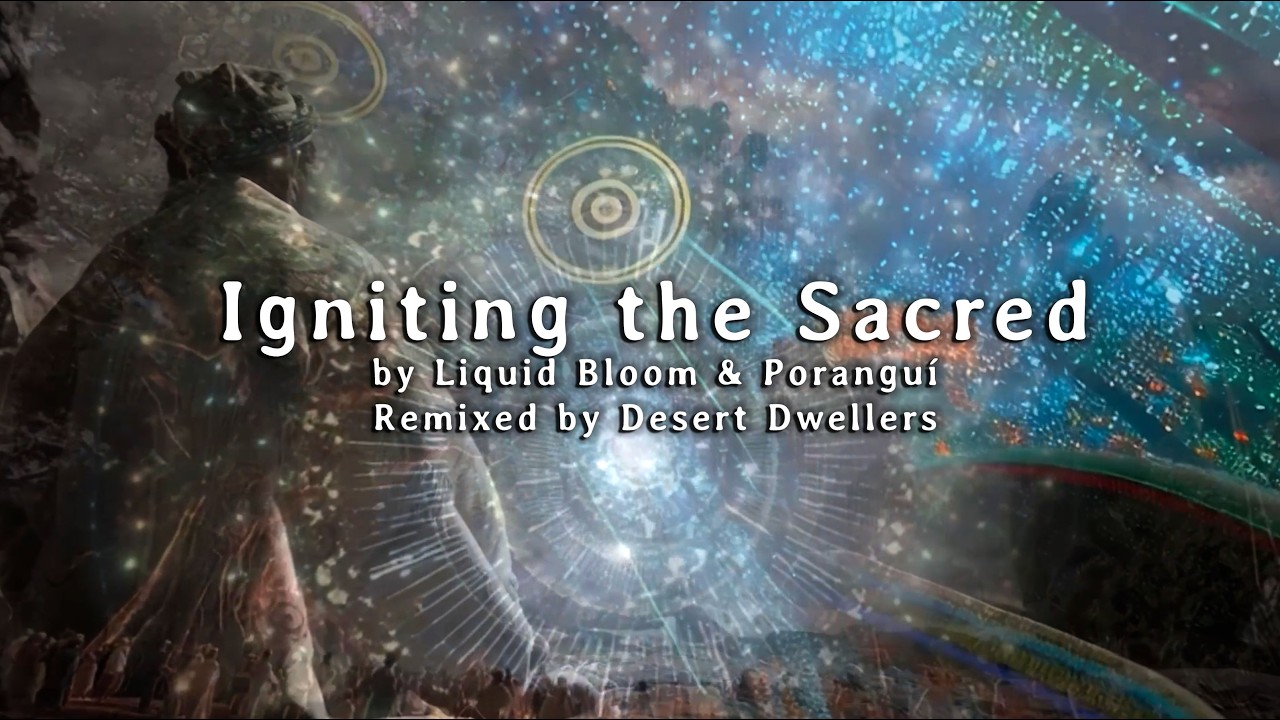
For four hours and forty-four minutes, a listener descends into a carefully woven sonic landscape: layered gongs and ambient pads give way to ethereal, floating timbres; the harmonics shift with hypnotic subtlety; visuals bloom and dissolve in tandem. This is immersive sound healing—not as a simple wellness amenity or background music for productivity, but as serious artistic practice designed to facilitate deep states of consciousness and transformation.
The journey in question was created to honor the Winter Solstice, that profound threshold moment when the Northern Hemisphere reaches its darkest point and the sun begins its return. It represents a significant evolution in how sound healing is practiced and offered: not as a solo session in a studio, not as an isolated practitioner with bowl and gong, but as a deeply collaborative work bringing together sound designers, electronic producers, visual artists, and the accumulated wisdom of multiple healing traditions.
What Changed in Sound Healing?
Sound healing itself is ancient. The use of sustained tones, gongs, singing bowls, chanting, and sacred sound to attune consciousness, support meditation, and facilitate ceremony spans cultures and millennia. Tibetan singing bowls, Vedic chanting, the didgeridoo in Aboriginal tradition, the shaman's drum in indigenous cultures worldwide—these are all expressions of an understanding that frequency, rhythm, and intentional sound carry healing power.
What has shifted dramatically in the last decade is both the scale and the collaborative method of creation. Where once a sound healing practitioner worked largely alone—with their instruments, their training, their intuition—contemporary sound healers increasingly collaborate with electronic producers, remix artists, visual artists, and fellow practitioners to create unified, immersive experiences. The 4:44-hour journey described here exemplifies this evolution perfectly: it features music from the Kuya Sessions (created in partnership with fellow "sound healing sonic wizard" Poranguí), alongside remixes by Tylepathy and bode, contributions from collaborators like PERE and Keepers of the Fire, and visuals by AI animator Wayne Visuals and mandala-animation artist DJ Relajado.
This is not a dilution or abandonment of sound healing's contemplative aim; it is an expansion and deepening of it. Each collaborative layer—the drone, the remix sensibility, the visual element—has been chosen with intentionality and coherence in mind. The result is a unified field, a single coherent experience rather than a patchwork of separate, competing elements. The listener does not encounter music plus visuals plus ambient sound; they enter a singular immersive environment.
Why Does Collaboration Matter?
Sound healing's turn toward collaboration reflects several profound truths: First, that healing frequencies and meditative states are strengthened when delivered through multiple sensory channels simultaneously. A sustained gong tone is powerful in isolation. But that same frequency, layered with complementary harmonic elements from other sound designers, supported by visual fractals or mandala patterns, enters the nervous system differently—more fully, with less resistance, with greater coherence. The body, the mind, and the visual cortex are engaged together, which amplifies the overall effect.
Second, collaboration reflects an understanding that no single artist holds all the knowledge or aesthetic sensibility needed to serve such work. The "sound healing sonic wizard" (the phrase itself appears in the project description, applied to Poranguí) is not a lone master standing outside or above tradition, but a member of a living lineage—one that includes both ancient wisdom and contemporary sound design, both gong traditions and electronic production sophistication. By bringing multiple specialists into a single project, the work becomes richer, more textured, and more likely to serve a wide spectrum of listeners with different nervous systems, histories, and needs.
Third, collaboration mirrors the very intention of sound healing itself: the recognition of interconnection, wholeness, and the understanding that separation is ultimately an illusion. If sound healing aims to help a listener feel their unity with all things—to transcend the illusion of separation and enter states of non-dual awareness—it makes profound sense that the work itself is not created in isolation but in relationship: between artists, between traditions, between the sonic and the visual, between the ancient and the contemporary.
Why Create at the Winter Solstice?
The deliberate choice to create this work specifically for the Winter Solstice is not incidental or merely seasonal. In many spiritual traditions—from Celtic and Germanic pre-Christian practices to Hindu, Mayan, and indigenous shamanic approaches worldwide—the solstices mark profound energetic and psychological transitions. The winter solstice, in particular, is the moment of maximum darkness, the nadir point where the sun reaches its lowest point on the horizon and the turning point where the sun begins its inexorable return.
Psychologically and spiritually, the winter solstice invites deep introspection, rest, and the renewal of intention. There is a natural human impulse at this time to turn inward, to release what no longer serves, to align with the returning light. Immersive sound healing timed to the solstice leverages this natural psychological opening. Listeners approach such work already primed to turn inward, to reflect, to drop into deeper layers of consciousness. The healing frequencies, the visuals, the carefully sequenced musical journey then amplifies and supports that innate seasonal shift. This is technology in its truest sense: a system designed to work with human nature and natural rhythms, not against them.
How Do Sound and Image Work Together?
Central to immersive sound healing is the deliberate integration of visual art. A listener engaging with a 4:44-hour journey does not simply hear; they see. The visuals are not decorative ornaments or secondary elements. They serve a specific, intentional function: to anchor consciousness in the present moment, to give the nervous system a clear focal point during deep meditation when the mind might otherwise wander, and to facilitate direct perceptual experience that can bypass the critical, narrative mind.
The visual artists who contributed—from AI-generated animations to hand-crafted mandala patterns and evolving geometric forms—create a complementary sensory stream that neither competes with nor simply mirrors the music. Where the music might take the listener inward and downward (into the depths of consciousness, into the body), the visuals can simultaneously expand, fractal, and guide without using words or narrative. This integration is a hallmark of immersive sound healing at its most sophisticated: the music and image are not separate tracks running in parallel, but interdependent aspects of a single unified intention.
Ancient Wisdom Meets Modern Craft
The project's stated philosophy is clear: it aims to "blend ancient wisdom with modern soundscapes." This is the animating creative tension in contemporary sound healing. The ancient wisdom—the deep understanding that sound, frequency, and intention carry genuine healing power—is not new. It stretches back millennia across cultures. But the methods of delivery, the tools of production and distribution, the techniques of audio engineering and visual art, and the sophisticated collaborations that make these works possible, are entirely of this moment.
A listener encountering this 4:44-hour journey is not stepping into a recreation of some historical practice or an attempt to capture what an ancient ceremony might have sounded like. They are encountering something genuinely, unapologetically contemporary: a work that honors its lineage while refusing nostalgia, that draws on tradition while fully embracing electronic production and digital visual art, that seeks to support inner work through the most advanced tools of aesthetics and technology currently available.
What Does the Musical Arc Reveal?
The sequence of tracks encodes a narrative arc of inner journey: it begins with "Pads & Gongs" (the foundational elements, grounding and stability), moves through "Refuge" and "Breathing in Serenity" (safety and calming), progresses to "The Call of Dawn" and "Inner Sanctum" (initiation and inward turning), passes through "Heart of the Mother," "Prayer of Protection," and "Path of Illumination" (protection, warmth, understanding), and culminates in "Return to Source" (homecoming and dissolution back into unity).
This structure—from grounding, through interiority, through illumination, to transcendence—maps the territory of deep meditation and shamanic journey that many seekers experience in their own practice. It provides a kind of musical container or template for that journey, whether the listener is engaging in seated meditation, ceremonial work with plant medicines, or unguided exploration of inner consciousness.
What Does This Moment Represent?
The simple existence of a 4:44-hour immersive sound healing experience, with nearly 280,000 views and collaborations among multiple sound and visual artists, points to a larger cultural shift: sound healing has moved from the esoteric margins into a recognized, respected art form. It is no longer available only to those with access to in-person teachers or ceremonies, able to book studio time with expensive practitioners. It is increasingly accessible, shareable through digital distribution, and sufficiently developed as a discipline that serious artists are dedicating years to its mastery and evolution.
Yet the fact that this particular journey was created intentionally to honor the Winter Solstice, that it draws on the Kuya Sessions and multiple lineages of sound work, that it integrates cutting-edge visual art with ancient harmonic and spiritual principles, suggests that sound healing is not simply being commercialized, diluted, or stripped of depth. Rather, it is evolving—becoming more collaborative, more multimedia, more integrated into a holistic vision of what it means to support human transformation through deliberate art.
Where to Go From Here
For those curious about immersive sound healing, the most direct entry point is the simplest: listen. Set clear intention, clear your schedule, and allow a full sonic journey to unfold without agenda or distraction. Immersive sound healing works—or others like it—can serve as a genuine introduction to the form.
Beyond simply listening, there is the deeper question of how sound healing actually works: what science and contemplative research can tell us about frequency, resonance, nervous system regulation, and the effects of sustained harmonic experience on human consciousness. That inquiry is increasingly part of the landscape of modern sound healing—a rigorous, curious, evidence-informed approach that does not dismiss ancient practice but seeks to understand its mechanisms.
Finally, there is the invitation to learn and create. Some listeners will encounter immersive sound healing and feel called to study its methods—to learn from sound healers and producers, to collaborate with other artists, to become active participants in the ongoing lineage. That too is part of the form's evolution: not passive consumption of content, but active engagement and co-creation of the healing work itself.