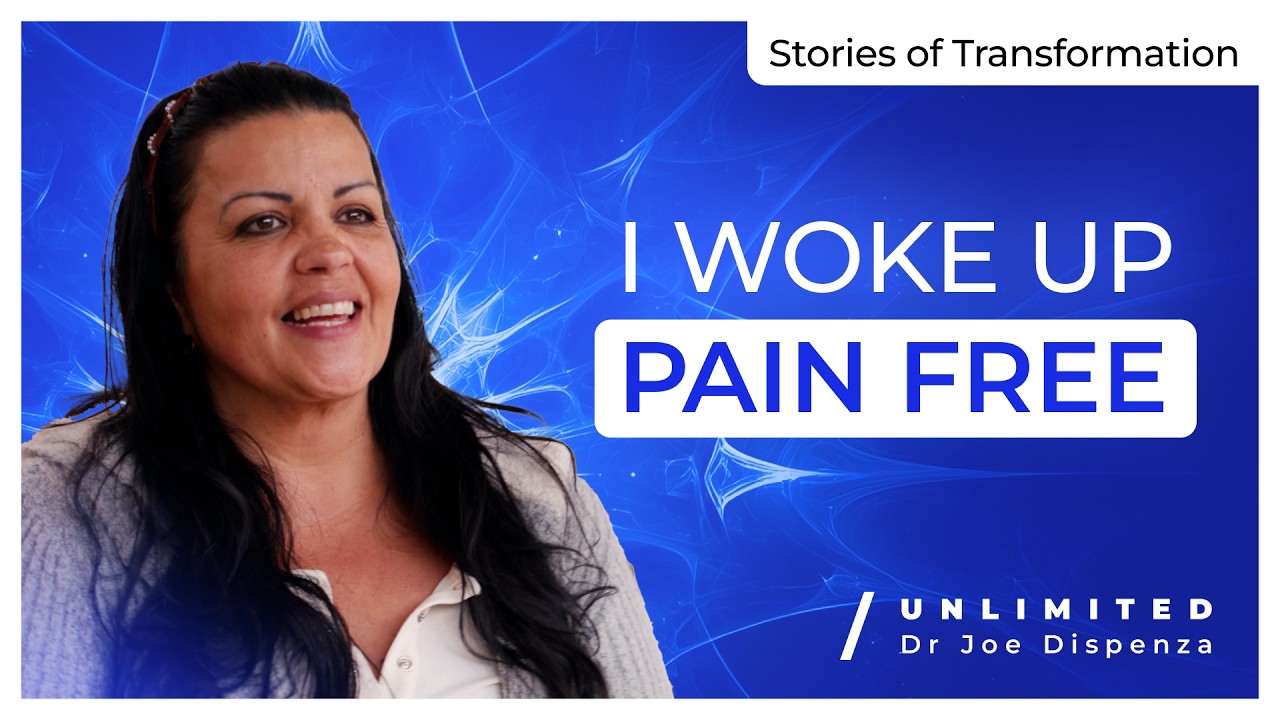
Michelle had lived nearly four decades under the weight of pain—feet burning since she was eleven, her body an ongoing mystery that healers couldn't solve, her mind dragging her into dark places. Then one afternoon, standing in her backyard looking at a fence, a single thought stopped her cold: "Oh my God, I can be a joyful person." It had never occurred to her before. Not because it was complicated, but because no one had suggested it—and she had never suggested it to herself. Five years later, she's not just pain-free and depression-free; she's learning to run for the first time in her adult life. Her transformation reveals a pattern that challenges everything modern medicine assumes about chronic illness: that the body's symptoms and the identity behind them are so intertwined that changing who you believe you are can quite literally change the flesh you inhabit.
What does a lifetime of unexplained pain look like?
Michelle's story began not in adulthood but in adolescence, in a body that no one could explain. At eleven or twelve years old, pain started flowering in her feet and spreading outward through her body. Her parents did what desperate parents do: they cycled her through healers, acupuncturists, chiropractors—practitioners who offered hope but no lasting relief. The pain was real; the diagnosis was elusive. She was young enough that the medical system couldn't easily categorize what she was experiencing, and old enough that the pain was shaping the architecture of her developing nervous system.
As she aged, the physical pain acquired a constant companion: depression. The sadness wasn't situational—it wasn't a response to loss or failure. It was constitutional, woven into her baseline emotional reality. There were days when getting out of bed was unthinkable, and other days when she was "completely fine"—the unpredictability itself a kind of torture, because if you're fine one day and unable to move the next, you can never quite trust your own stability. She tried to manage it the way many adolescents in crisis do: by turning pain inward. She cut herself.
For decades, Michelle lived with this duality, trying every modality available to someone with access and desperation. Therapy helped—temporarily. Plant medicine journeys opened doors to understanding—but the insights wouldn't stick to her cells. The pain would recede, and then return. The depression would lift, and then settle back in like a seasonal weather pattern she couldn't escape. At some point, you stop believing in cure and start just managing symptoms, and that's where Michelle was living by the time she reached adulthood: in the chronic accommodation of suffering.
In 2019, finally, she received a diagnosis: fibromyalgia. Doctors initially suspected cancer—the inflammation in her body was severe enough that it triggered that concern—but testing revealed it was fibromyalgia, a condition characterized by widespread musculoskeletal pain, fatigue, and cognitive difficulties. Looking back at her life, Michelle suspects she'd had it her whole time—the chronic, systemic inflammation that meant her body was telling a story of suffering that medical science could identify but not resolve. It was a name for her lifelong mystery, but a name without an exit strategy.
Why did she agree to go to a meditation retreat?
Michelle didn't want to go. She was skeptical of the teacher—some man named Joe Dispenza whose work she'd never encountered. She preferred following women, women's circles, women's empowerment frameworks. And practically, she didn't want to leave her young children for seven days, a gap that felt reckless when you're already managing pain and depression. Her husband had decided to attend what he'd been told was a retreat of some kind. Eventually she made the choice that many reluctant spouses have made: better to go together than to have him go alone, at least then they'd be absent from the home for the same duration.
What she didn't know—what her husband apparently hadn't disclosed, finding the revelation more effective in person—was that she was attending a meditation retreat. The entire week would be spent in group meditation. She discovered this after arrival, when the structure was already set, and by then her skepticism had already been activated by circumstance rather than just prejudgment.
But something unexpected happened immediately. At registration, Michelle had filled out a questionnaire, listing her symptoms without much expectation that they mattered or that anyone would actually read them carefully. A volunteer approached her and handed her a card. The card read: "It's time to fall in love with life again."
That sentence struck her with the force of recognition. She hadn't thought of life as something to fall in love with. Pain and depression don't typically coexist with love—they coexist with survival, with endurance, with the fragile hope that today will be more bearable than yesterday. But the card offered a different frame: not healing pain, not resolving depression, but rekindling a relationship with existence itself. It was an identity shift—from "sick person in recovery" to "person capable of loving their life." And she had never considered it.
What happened when hundreds of strangers started laughing?
Michelle was chosen to serve as a "Healy" during the retreat, a role in the research component of the event that typically means being especially attentive to one's own experience and process. She had filled out the intake questionnaire without thinking her symptoms particularly significant, but something in those answers had flagged her for inclusion. This was significant, though she didn't know it yet.
During the week, Michelle had three significant healing experiences—moments where something shifted in her nervous system, her body, her sense of what was possible. But one stood out with particular vividness and power. In the group meditation space, which was a massive ballroom, someone began to laugh—not a nervous giggle or a polite chuckle, but deep, genuine, contagious laughter. The kind that seems to spread through a room like electricity through water.
Then the entire ballroom caught it. Hundreds of people laughing together, meditation dissolving into joy. Michelle found herself laughing and crying simultaneously, her body oscillating between release and joy, her heart opening in the presence of collective feeling. "I felt so beautiful and wonderful," she would later recall. It was the kind of moment that cracks something open—when you're in a room full of strangers and suddenly you feel held, seen, invited into a collective experience of lightness. Your nervous system recognizes: this is possible. Joy is real. Connection is real. And if it's real here, it might be real elsewhere. It might even be real for me.
By the end of the week, Michelle was not just changed; she was convinced. On Monday, she returned home. On Wednesday—just two days later—something she'd been wanting to accomplish happened effortlessly. It was something that had seemed impossible to everyone around her, something the practical consensus said could not occur. But it happened. "I was hooked," she said. "I was like, 'Oh my God, this works.'"
How does reading a book become a breakthrough?
Michelle dove into Dr. Joe's published work, moving sequentially through his books from the beginning. When she reached Breaking the Habit of Being Yourself, something in the title and content reached her differently than any other teaching had. The book wasn't about healing fibromyalgia or curing depression. It was about the radical possibility of becoming a different person entirely—not incrementally improving, but fundamentally reorganizing your personality, your habits, your sense of self.
The title alone carries a claim that's simultaneously terrifying and liberating: you are a habit. Your personality is something you've practiced so consistently, so repetitively, that it has calcified into what feels like you—your true self, your essential nature. But habits can be unlearned. Personalities can be rebuilt. The person you are right now is the result of thousands of daily micro-choices, and different choices compound into a different person.
Michelle was at home one day, doing a walking meditation in her backyard, turning over these ideas, letting them integrate into her nervous system. She wasn't forcing anything. She was simply present to the thought-space the book had opened. And then came the moment—specific enough that she would remember it vividly years later, specific enough to mark it as a before and after in her life.
She looked at a fence. And in that moment, the thought arrived, unbidden and complete: "Oh my God, I can be a joyful person" (198s). The simplicity of it was revolutionary. Not "I should try to be happier." Not "If I heal my pain, then I can be joyful." Not "Someday, when circumstances improve, I might experience joy." But: I can adopt joy as a core identity trait, right now, starting this instant. I can decide to become someone for whom joy is a baseline, and I can practice that identity until my nervous system believes it, and I can do this before the pain is healed, before the depression is cured, right in the midst of everything that's been wrong.
"And that had never occurred to me before," she emphasized. It's a striking admission. A lifetime of self-improvement culture, of therapy, of spiritual seeking, and no one had ever suggested—and she had never suggested to herself—that she could simply decide to be joyful and then practice being that person until it became real, until her cells believed it, until the brain and body synchronized around a new identity.
How do you actually recreate yourself?
From that moment forward, Michelle made a daily practice of conscious identity reconstruction. Every time she felt the pull into victimhood—the narrative that she was broken, that her body was her enemy, that she was defined by limitation—she stopped herself. Every time sadness started to narrate her inner world, she interrupted the pattern. She wasn't suppressing the feeling or denying what was real; she was choosing who she was going to be in relationship to those feelings.
"I told myself to stop," she said (206-211s). "And then it just... the depression lifted."
This is the mechanism beneath the teaching: that consciousness doesn't just observe reality passively like a mirror. It shapes reality. Your nervous system, your body, your cells are paying attention to the story you're telling about who you are. They're listening to the narrative you practice most consistently. If you've spent thirty years practicing the habit of being a person in pain who is depressed, your biology becomes fluent in that identity. Your neurotransmitter levels adjust to support that story. Your pain receptors calibrate to that baseline. To change the body, you have to first change the identity it's reflecting and reinforcing.
Michelle was not meditating specifically on fibromyalgia healing. She was not visualizing pain disappearing. She was meditating on being joyful. She was practicing a personality. She was becoming—not in some abstract spiritual sense, but in the most concrete neurobiological sense, retraining her brain and nervous system through repetition and emotional authenticity.
What happened to the pain?
About a year into this practice of reconstructing her identity around joy rather than around pain, someone asked her a direct question: "Okay, well, you're not depressed anymore. What about the fibromyalgia?"
Michelle had to pause. She actually had to think about it. The question caught her off-guard because she hadn't been consciously monitoring for the pain's absence.
"What fibromyalgia?" (228s) she finally answered.
She realized—with the kind of surprise that comes from genuine transformation, not wishful thinking or positive thinking—that her body didn't hurt anymore. The pain that had defined her since childhood, the inflammation that a doctor had finally named in 2019, the physical suffering that no modality had been able to touch: it had dissolved. Not gradually, not through pharmaceutical intervention, but through the shift in her fundamental identity.
But Michelle didn't immediately declare victory. She waited a full year before giving a formal testimonial about her healing, wanting to ensure it had truly stuck. She had tried so many things before—therapy, plant medicine, acupuncture, chiropractic care. She had experienced temporary relief and then watched it fade. She wasn't going to celebrate a false dawn, to claim a miracle and then have to recant it six months later.
The pain didn't return. The depression didn't return. Five years have now passed since that backyard moment, since she decided to become a joyful person. The depression remains absent. The pain remains absent. And most remarkably, she can run—something she was never able to do before, when her body's baseline was suffering and her nervous system was wired to experience pain.
"The most mystical thing about this work," she reflected (246s), "is that you can really change your personality and change your reality."
Where to go from here
Michelle's story arrives at a moment when many people are asking essential questions about the relationship between mind and body, between identity and health, between the stories we tell about ourselves and the physical lives we actually live. Her five-year track record—not just the absence of pain and depression, but the presence of new capacities like running—suggests that the answer to "Can you heal chronic illness through consciousness?" might be more nuanced than either mainstream medicine or wellness culture usually admits: Yes, but not through positive thinking alone. Through identity reconstruction. Through becoming a different person.
That reframing is the real teaching. Not that positive thinking magically cures disease (a claim both scientifically shallow and emotionally cruel to people still suffering). But that the self is not fixed, that identity is something you practice daily through your choices and your attention, and that the body follows where consciousness consistently leads.
For anyone sitting with chronic pain, with depression, with the exhaustion of trying every external solution, of cycling through practitioners and modalities and hope and disappointment: Michelle's moment in the backyard—the moment she realized she could be joyful, that joy wasn't dependent on circumstances but on choice—is an invitation. It's an invitation to ask yourself a question you may never have asked before in quite this way: Who do I want to become? Not someday, when everything is healed. But now. Right now. What if the pathway to healing isn't fixing what's broken, but becoming the person who is whole?