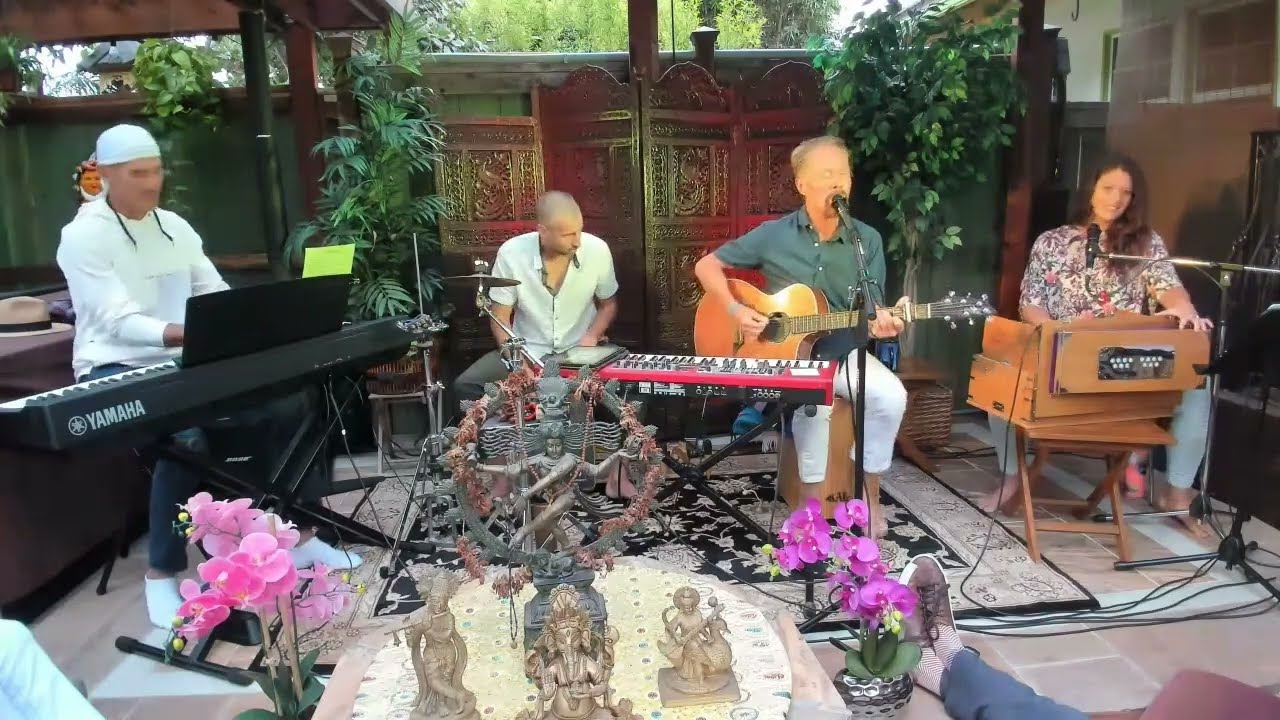
Nearly seven minutes of repeated vocal tones. No lyrics to catch. No narrative arc delivered in English. Just breath, sound, and the patient unfolding of a single melodic shape across what appears to be a single sustained harmonic field. "Diamonds in the Sun," the title track from Girish's 2019 album of the same name, is kirtan reduced to its most essential element: the voice as an instrument of stillness.
Kirtan—the Sanskrit term for "naming" or "praising," rooted in devotional Hindu and yogic traditions—typically unfolds as call-and-response chanting, often structured around a mantra or the names of deities. A lead vocalist sings a line; a group echoes it back. There is movement, momentum, and a kind of musical dialogue meant to draw practitioners deeper into meditative states through repetition and communal presence.
Girish's approach on "Diamonds in the Sun" abandons the call-and-response format entirely. What remains is closer to what some traditions call "nada yoga"—the yoga of sound itself. The voice becomes a tool not for storytelling or even for specific invocation, but for the exploration of resonance, sustain, and the subtle movements within a held tone. It is kirtan abstracted into its pure sonic essence: a tone held, variations introduced with breath and subtle shifts in pitch, then released.
The power of "Diamonds in the Sun" lies in what neuroscientists studying meditation have begun to understand about repetitive sound: when the mind is released from the work of tracking narrative or decoding meaning, it can settle into a different mode of processing. The repeated vocal tones act like a tuning fork for the nervous system, inviting the listener (or the practitioner sitting with the piece) to align with a sustained frequency rather than to follow an arc.
The title itself suggests why this matters. In yogic and Vedantic philosophy, the inner self—atman or Brahman—is often described in luminous terms: as a diamond, a light, or an unchanging radiance that persists beneath the flux of experience. By removing the scaffolding of narrative and lyrics, Girish's piece creates space for the listener to encounter that inner luminosity directly, without mediation. The "sun" referenced in the title may be both literal (the central illuminating principle) and metaphorical (an invitation to recognize one's own inner brightness).
There is a lineage in spiritual music toward restraint. In Gregorian chant, the prolonged vowel tones of Latin liturgical singing create a similar suspension of time. In Sufi vocal practice, a single phrase may be sung dozens of times until the words dissolve and only the breath remains. Girish's work carries that sensibility into a contemporary context—a 6m58s offering that respects the listener's capacity for stillness rather than competing for attention through variety or complexity.
This is not music meant to entertain or to provide a narrative journey. It is music meant to serve as a mirror: to reflect back the listener's own presence, to create a space where thought can settle, and to offer the suggestion that within silence and sustained tone, there is a kind of diamond-like permanence that cannot be disturbed. Whether that recognition arises for a listener depends less on the sophistication of the composition and more on their willingness to meet the work in that quality of attention.
If you are drawn to "Diamonds in the Sun" but feel uncertain how to approach it, consider the practice of simply sitting with the piece in the early morning, when the mind has fewer accumulated thoughts. Let the repeated tones wash over you without the effort to "do" anything with them. The invitation in this kind of minimalist kirtan is not to achieve a particular state, but to stop constructing states altogether—to allow what is already luminous within you to be recognized in its own light.