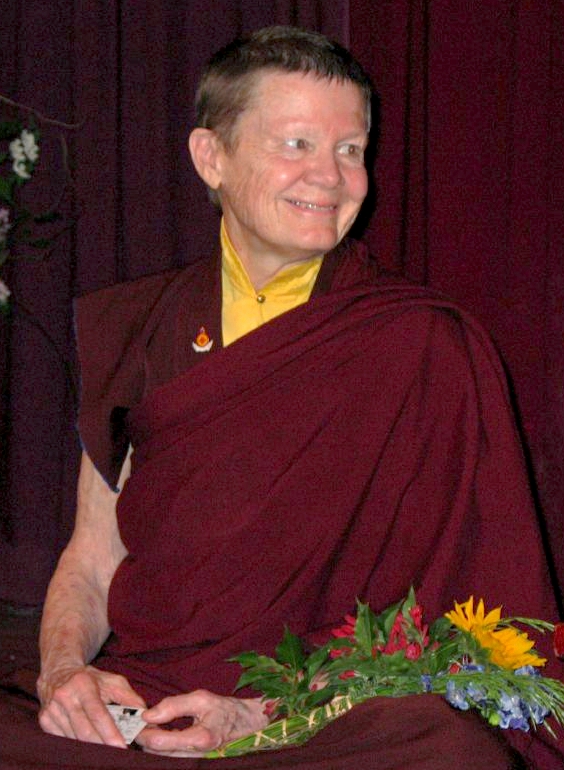
In this talk from her 2009 "Smile at Fear" retreat at Omega Institute, Pema Chodron grounds fearlessness not in the absence of anxiety but in cultivating unconditional friendship with yourself—a practice rooted in Shambhala teachings about human potential. She presents genuineness as the life force animating the path of courage, explains why facing your weaknesses actually builds strength, and introduces meditation and a particular way of viewing your life as the two major tools for learning to stay with yourself when fear and aversion arise.
At the heart of Pema Chodron's teaching in this talk is a radically trusting view of what humans are capable of. Rather than beginning from a premise of human flaws or damage, the Shambhala teachings—particularly those transmitted by Chögyam Trungpa Rinpoche, whom Chodron studied under—start with the conviction that each of us contains real capacity for awakening. "We could live in a way as individuals and as a society where we called on our potential... our ability to open up our hearts and minds our ability to be kind our ability to care about each other our ability to love our ability to be generous our ability to have a sense of humor" (0:00). This is not positive thinking or denial of real suffering; it is a foundational trust in latent human qualities that can be developed through practice.
What makes this view practical, Chodron explains, is the decision to stop interpreting ourselves and others primarily through the lens of flaw. "Rather than seeing each other as flawed or seeing ourselves as flawed we see ourselves as full of potential to keep our hearts and minds open no matter what is happening in the outer circumstances" (0:70). This doesn't mean ignoring problems or pretending difficulty doesn't exist. Instead, it means holding a different frame: that our basic nature includes the capacity to remain open-hearted and mentally flexible regardless of external pressures. This foundational view then shapes how we relate to our own fear and weakness.
Chodron identifies genuineness as the primary ground for developing true courage. "Genuineness becomes kind of the basis of the path of cultivating courage the path of fearlessness begins and continues and ends it's like the breath that you breathe into this path it's the it's the life force of the path of fearlessness is genuineness" (0:90). This is a precise teaching: fearlessness is not built on bravado or the suppression of doubt. It is built on a willingness to be authentic with yourself.
Genuineness, in this context, means two things. First, it means not being afraid of your own inner landscape: "not be afraid of ourselves and to be able to have an - to practice and cultivate so that our friendship with ourselves becomes more and more uncondition" (0:116). Second, it means refusing to perform a false version of yourself for others. "Our ability to not feel we have to fake it to make people think we're more together than we are but just being able to be honest with ourselves allows us to be open to our world if to the degree that we're open to ourselves we can be open to other people and to the world" (0:134).
The logic here is interconnected: to the extent you can be authentic internally—acknowledging your real thoughts and emotions rather than defending against them—you become capable of genuine openness to others. Faking coherence requires constant vigilance and creates an inward closure. Authenticity, by contrast, frees attention outward.
A cornerstone practice Chodron introduces is cultivating "unconditional friendship" with your own experience. "Unconditional friendship is the ongoing exploration and the ongoing practice of cultivating an unconditional friendship" (0:170). This phrase might sound abstract, but the question Chodron poses clarifies it: "How do I stick with myself when I actually have an aversion or deep fear or a sense of it's tremendous feeling of anxiety?" (0:196). In other words: how do I remain present and kind toward myself precisely when my impulse is to reject, judge, or run from what I'm feeling?
Unconditional friendship means you stop abandoning yourself in the presence of your own difficulty. Most of us have been trained to abandon ourselves as soon as something uncomfortable arises: we numb, distract, judge ourselves harshly, or contract. Chodron is teaching a radically different move: to stay present to yourself with kindness and curiosity, even when—especially when—your weaknesses, fears, or uncomfortable sensations emerge.
One of Chodron's most striking teachings in this talk concerns the relationship between weakness and strength. She introduces the teaching of Chögyam Trungpa Rinpoche on this point: "When you when you face yourself when you're to the degree that you're willing to face yourself and face your fear and come to know your fear so intimately you sort of know it's smell it's taste its color its texture and you particularly begin to be very wise about knowing what it triggers in you and all the different ways that you try to run away from the feeling the emotion the sensation of fear" (0:278).
This teaching suggests that real strength does not come from denying or transcending your vulnerabilities. Instead, it comes from intimate familiarity with them. When you truly know your fear—not intellectually but sensorially and emotionally—you become wise about its movements. You recognize the specific patterns it triggers in you. You see clearly the strategies you employ to escape it. This self-knowledge is the ground of genuine strength because it means you are no longer unconsciously reactive.
The ultimate instruction is equally striking: "When you turn toward your fear when you move closer to it you don't right away discover courage he said instead what you discover is a kind of shaky tender vulnerability" (0:361). Chodron and Trungpa are saying that approaching your fear directly does not immediately deliver the experience of being brave. What you discover first is vulnerability—a trembling openness. But this vulnerability, this willingness to be affected and exposed, is the actual substance of real strength. It is the discovery of strength not as armor or invulnerability, but as the capacity to stay present to the full texture of your life.
The YouTube description mentions "the genuine heart of sadness" as a basis for nonviolent warriorship. Though Chodron's teaching in this excerpt does not elaborate extensively on this phrase, it connects to the overall arc: that authentic strength emerges not from hardness or triumph over difficulty, but from openness to the full range of human experience, including grief, tenderness, and sorrow. The "genuine heart of sadness" is perhaps the recognition that to be open to others and to care about the world is to be touched by its pain. This tenderness is not weakness; it is the ground of genuine compassion and the willingness to act ethically.
Chodron identifies meditation as one of the two major practical tools (the other being a particular way of viewing your life). "Meditation itself meditation it just presents a way of being with yourself in a genuine way and not faking it and being able to look deeply more and more deeply as the years go on at one's emotions at one's thoughts at one's habits and patterns" (0:230).
In this teaching, meditation is not presented as a technique for achieving bliss or emptying the mind. Rather, it is a laboratory for practicing unconditional friendship with yourself. On the cushion, you encounter the same patterns, fears, and resistances that arise in daily life, but in a contained, intentional setting. Over time, this repeated practice of noticing without judgment, staying present without faking, creates the capacity to do the same off the cushion. Meditation trains the mind to remain open to your own experience.
The description references "nonviolent warriorship." Chodron's teaching clarifies what this means: strength that is rooted in genuineness, vulnerability, and openness rather than in domination, hardness, or the need to prove yourself. A nonviolent warrior is someone who can stand in difficulty without contracting into defensiveness. Someone who can face opposition, injustice, or fear without abandoning their own heart. Someone whose strength comes from refusing to shut down, even when shutting down would be easier.
This is profoundly different from passive acceptance. It requires tremendous activity: the activity of staying present, remaining kind to yourself, continuing to trust human potential even when that trust is tested. The warrior in this context is the person who refuses the small death of numbing or hardening, and who instead keeps practicing genuine connection and openness.
This talk offers a foundation for several deeper explorations. Readers drawn to Chodron's work might study her books such as When Things Fall Apart or Pema Chodron's How to Meditate for more detailed guidance on meditation practice and the application of these teachings. The concept of tonglen (sending and taking) practice, central to Tibetan Buddhism and often taught alongside these principles, offers a concrete method for developing unconditional friendship with others through compassion. Those interested in the broader Shambhala vision of human society might explore Chögyam Trungpa Rinpoche's Shambhala: The Sacred Path of the Warrior to understand the cultural and philosophical context of these teachings. Finally, the teaching on the relationship between vulnerability and strength deserves continued contemplation: what happens when you stop fleeing your own difficulty and instead turn toward it with curiosity?