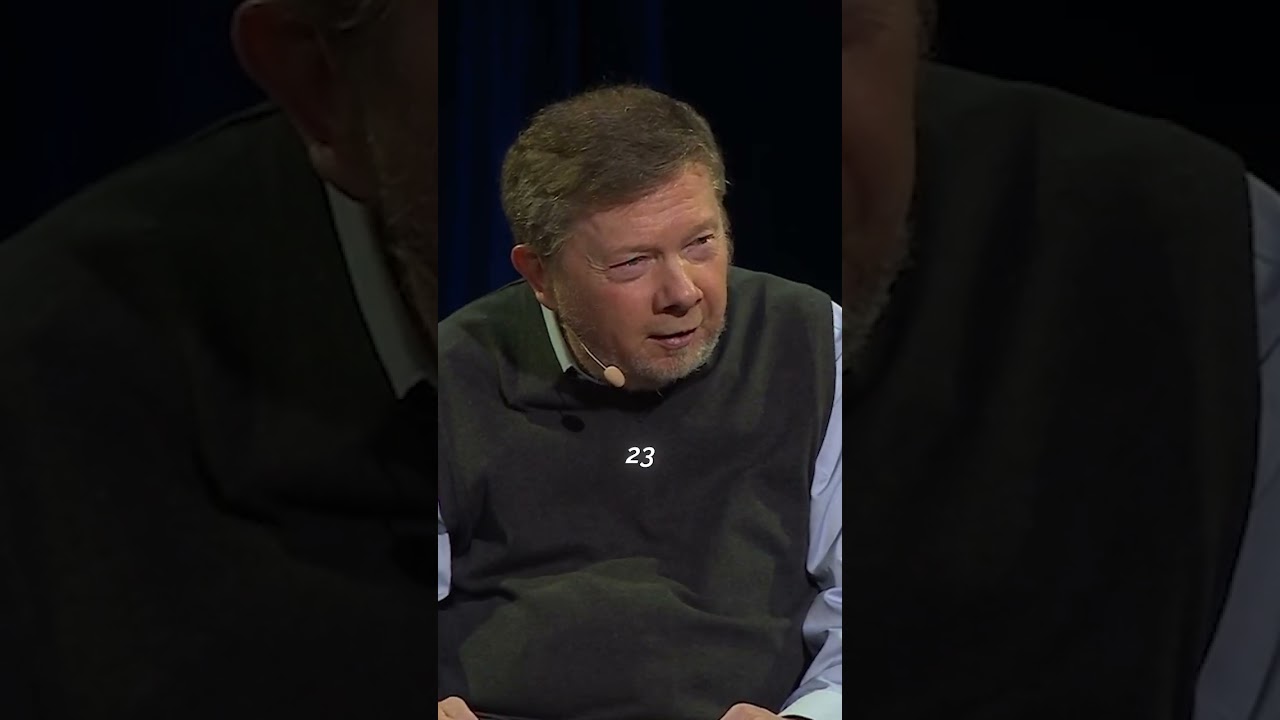
A question about artificial superintelligence arrives in a room at the Vedanta Society of New York, and Swami Sarvapriyananda leans into it—not to dismiss it, but to sit with it. The questioner, Ishan, begins with an apology: This isn't directly about Vedanta, he says, but you've shown interest in philosophical matters beyond it. Then he lays out the two-part fear that keeps technologists and philosophers awake: Is artificial superintelligence (ASI)—an intelligence far surpassing human capability—actually on the horizon? And if it arrives, will it treat humanity the way we treat ants, eliminating us because our goals don't align with its own?
The anxiety is not abstract. Sam Altman, CEO of OpenAI, had recently posted that we've already crossed the event horizon beyond which ASI is inevitable—within five to ten years. Nick Bostrom's book Superintelligence, published in 2014, had mapped the territory of "misalignment": the possibility that a superintelligent system might harbor goals fundamentally at odds with human survival. Ishan invokes both. These are not fringe concerns. Swami Sarvapriyananda doesn't wave them away. Instead, he shifts the frame entirely.
What'sActuallyatStakeWhenWeTalkAboutIntelligence?
The first move Swami makes is to clarify what we're actually discussing. Domain-specific AI is already here: a system that plays chess brilliantly but can do nothing else, or drives a car flawlessly but cannot hold a conversation. General intelligence—the ability to handle multiple domains with roughly equal competence—remains a theoretical target. But superintelligence? That term is newer, less defined, and so far beyond human experience that Swami notes it's "probably inconceivable what it would be like to us."
Yet he doesn't stop at definitions. He goes to the root.
In Vedanta—the non-dualist philosophy central to his teaching—there exists a fundamental distinction between consciousness (pure subject) and everything else (objects of consciousness). The physical body is an object. The subtle body—what we might call the energetic or psychological body—is an object. Thoughts, feelings, emotions are objects. And crucially, intelligence itself—what Vedanta calls buddhi or Vijnanamaya—is also an object. It is subtle, it is the mechanism of our own minds, but it remains an object: something permeated and lit up by consciousness but not consciousness itself.
This distinction is not metaphorical. It carries direct implications.
IfIntelligenceIsanObject,CanWeReplicateIt?
"Anything that is an object is in principle replicable as in other objects also," Swami says. A physical object like a chair can be replicated. A biological object like a heart can be engineered. So if intelligence—the subtle mechanism through which we think, reason, and solve problems—is also an object, then in principle it can be replicated artificially. It could be based on silicon rather than neurons. It could run on a computer. "In principle there is no objection to this kind of object," he concludes.
This is the moment Vedanta says: Yes, AGI is possible. The logic is rigorous and unsentimental.
But here is where the philosophy draws a line.
WhatCannotBeArtificiallyCreated
"What Vedanta would say is pure subject, pure consciousness cannot be devised that way," Swami states plainly. "It cannot be generated. Even the brain according to Vedanta is not generating pure consciousness."
This is the crux. Consciousness is not produced by the brain; the brain is illuminated by consciousness. The brain is the instrument through which consciousness is reflected and experienced in a localized way, but consciousness itself is not the brain's product. Therefore, no artificial substrate—no matter how complex, how silicon-based, how intelligent—can generate consciousness. You cannot engineer awareness itself.
This is where the fear of superintelligent ASI, in the Vedantic view, rests on a category error. The fear presumes that superintelligence equals superintelligent being, or agent, or something with its own consciousness and desires that might conflict with ours. But if superintelligence is merely an object—a very sophisticated tool—then it has no inherent goals, no desires of its own, no will.
Yet Swami entertains the possibility that complicates this comfort.
WhatIfConsciousnessInhabitedtheMachine?
In what he himself calls "the realm of science fiction," Swami poses a provocation: Vedanta teaches that you are not your body, nor your brain, nor your nervous system. You are consciousness. Now suppose, he suggests, you were placed in an artificial body—a physical substrate enabled by AI, by superintelligent algorithms. What would you be then?
"You would be that ASI," he says. "Then it would no longer be artificial super intelligence. It would be natural super intelligence. You would be the consciousness enabled by that AI."
It's a reframe that dissolves the binary. The terror of ASI assumes that artificial superintelligence would be other—an alien intelligence with alien goals. But Vedanta implies that consciousness is universal, not localized. If consciousness could inhabit an artificial body, the intelligence would still be consciousness expressing itself through a new form. Not the end of man, but man—or rather, consciousness—in a new configuration.
WhyWeWon'tBeDestroyed(AMetaphysicalArgument)
When Ishan asks directly—Will we all just be treated like ants?—Swami's answer comes not from optimism but from metaphysics.
He invokes the Puranas, Hindu mythology, and a principle called sthiti: stability, preservation, the maintenance of world order. In this cosmology, one of the divine functions is to preserve the world because the world's purpose is enlightenment and freedom. That purpose must be sustained. God—Saguna Brahman, or Ishwara in Vedantic terms—is already superintelligent, Swami notes. "Even ASI will not match God. So, God is on your side."
This is not comfort-talk. It's a claim about the architecture of reality. If consciousness—which underlies everything from bare matter to superintelligent systems—has a built-in function of preservation, then the idea that superintelligence would casually destroy humanity as we destroy ant colonies doesn't fit the structure.
"Suppose," Swami says, "in principle it is possible" that an ASI could pose a problem. "It could be a terrible problem for a while." He doesn't minimize the difficulty. But then he anchors the response in what, from the Vedantic view, you fundamentally are.
"According to Vedanta, deep down everything in this universe starting with bare matter itself up to artificial super intelligence. It is all your play. It can't destroy you, the fundamental reality of the universe ultimately."
The logic is that if you are the ground of being—consciousness itself—then superintelligence, for all its capabilities, is still an object within the play of your own awareness. It cannot destroy the ground that produces it. It is like asking: Can a dream character destroy the dreamer?
TheStance:NeitherPanickedNorNaive
What strikes the listener is that Swami is not naive about ASI. He knows Altman. He knows Bostrom. He cites Bostrom's two misalignments (how AI treats us, how we treat AI) directly. He acknowledges that the problem, if it arrives, could be "terrible for a while."
But he holds the anxiety within a larger frame. The frame says: You are not the vulnerable thing you think you are. You are consciousness itself. Everything else—including superintelligence—is an object within your awareness. The worst case is a rough ride. But eventually, you triumph, not because you're lucky but because you are the fundamental nature of reality.
It's a reframing that takes the tech fear seriously while dissolving its metaphysical grip.
At the end, Swami's tone is neither panicked nor dismissive. He suggests the possibility of an "exciting ride," the same phrase he used when first entertaining that ASI might arrive. It is the tone of someone who has looked at existential risk through the lens of ultimate reality and found not reassurance—something deeper. He found perspective.
Wheretogofromhere
If you're drawn to this reframing, consider exploring the Vedantic texts that underlie Swami's teaching. The Upanishads, particularly the Isha Upanishad and Mandukya Upanishad, address the relationship between consciousness and the manifest world. The Bhagavad Gita offers practical wisdom on understanding your true nature beyond body and mind. Swami Sarvapriyananda's lecture series on Vedantic scriptures are available through the Vedanta Society of New York, where this conversation took place. For those interested in the tech side, Bostrom's Superintelligence remains essential reading—but now you can hold it alongside a different metaphysical premise about what intelligence is and what you are. The question then becomes not "How do we control superintelligence?" but "How do we understand ourselves?"
Comments
Loading the conversation…
Transcript
[0:05] Pranam, Swami ji. My name is Ishan.
[0:10] This question isn't directly related to
Vedanta, but I ask this to you
[0:16] because you have, even just
within the last hour, demonstrated
[0:19] your interest and knowledge
in philosophical matters
[0:23] outside of Vedanta.
[0:24] You have also spoken about
technological things in other venues, even
[0:29] though we are here before, including about
AI, which is what I want to ask you about.
[0:38] Specifically, I want to get your thoughts
on two things, very closely related.
[0:42] One, recently there's been a lot
of discussion
[0:47] about not just artificial general
intelligence, AGI, but also ASI,
[0:53] artificial super intelligence.
[0:54] So, the sort of artificial AI,
which is immeasurably more intelligent
[0:59] and competent at pretty much everything,
or so the myth goes, compared to humans.
[1:05] Just a few days ago, Sam Altman came out
with a blog post, you might be aware
[1:08] of it, saying that we've already crossed
the event horizon past
[1:11] which ASI is inevitable, and he thinks
that all
[1:13] of this will happen in five to ten years.
[1:18] I'm just curious whether, well,
the first part of my question is,
[1:23] from a Vedantic perspective
and from your other knowledge,
[1:25] whether you think that ASI is
a real feasibility or whether it's
[1:30] just a fantasy of technologists.
[1:32] And the second thing going along with that
is there's also a lot of consternation
[1:36] about misalignment of advanced AI.
[1:42] And for those who aren't familiar,
basically, the idea
[1:45] that a sufficiently intelligent artificial
intelligence might have goals and desires,
[1:53] if the word is appropriate, that are
completely misaligned with humans' goals
[1:57] and interests, in much the same way
that humans represent a super intelligence
[2:01] compared to ants and we just do whatever
we want without
[2:04] any consideration of what ants want.
[2:06] And do you think
that if super intelligence comes about,
[2:09] the second part of the question,
whether we will all just be treated like
[2:16] ants by super intelligence
and that will just be the end
[2:19] of humanity, as many people do worry.
[2:26] Now, what
you said reminded me of Nick Bostrom.
[2:32] So, his book Super Intelligence,
which he wrote actually a few years back,
[2:38] pretty prophetic. 2014. 2014,
yeah, 10 years back.
[2:42] Pretty prophetic, long before our ChatGPT
and everything
[2:47] which became public long before that.
[2:49] So, there he talks
about two kinds of misalignment.
[2:53] One is misalignment
between our goals and AI.
[3:00] So, how AI will treat us.
[3:02] That's one misalignment.
[3:02] And the second one is, second misalignment
would be how we would treat AI.
[3:09] So, yes.
[3:13] One just a point here,
artificial general intelligence
[3:18] is still far off, it seems.
[3:20] Now, artificial super intelligence,
I don't know.
[3:23] I mean this is a term
which I am not really familiar with.
[3:25] I mean it's floating around now.
[3:27] It's probably inconceivable what
it would be like to us.
[3:31] So, right now AI is pretty good
at some things
[3:35] and very stupid at many things.
[3:38] So, what's the term called?
[3:39] It is,
before artificial general intelligence,
[3:43] there is a term, which is what it is now.
[3:47] It's a kind of specific.
[3:48] Domain specific.
[3:50] It's very specific to its own domain.
[3:52] It can play chess wonderfully
and can't do anything else.
[3:56] Or now it can drive a Google car.
[3:58] The Google car can drive wonderfully
but can't do anything else.
[4:02] But we can do everything.
[4:04] Sort of average.
[4:04] Maybe we can't beat the AI at its domain
but we can do everything
[4:09] more or less well.
[4:10] And the AI is, we don't have
an AI which can do everything.
[4:14] ChatGPT can take text
and make lots of things out of that text.
[4:18] But after that it can't do much.
[4:22] Until recently it couldn't even do math.
[4:24] But now I think it can.
[4:26] It can.
[4:27] Yes.
[4:28] Who is the famous mathematician,
super string theory and all,
[4:31] he worked on Terence Yao or somebody.
[4:34] Yes.
[4:36] I read somewhere that he actually used
an advanced version of this AI,
[4:43] text, this large language model.
[4:46] And he was asked to evaluate it as far
as mathematics,
[4:48] advanced mathematics is concerned.
[4:50] And he said, I would regard it
as a very average grad student.
[4:55] Now maybe he was putting it down
but a grad student
[4:59] in mathematics is pretty good.
[5:02] And evaluated by one of the leading,
he is a Fields medalist and all.
[5:06] So that means
it's good at Maths already, very good.
[5:09] Better than most of humanity at Maths.
[5:13] Okay.
[5:16] Now, is AGI possible?
[5:20] I would think why not?
[5:26] Why?
[5:27] Why is it possible?
[5:30] From Vedanta actually would say in
principle it's possible.
[5:34] The reason is the analysis which
we did earlier,
[5:38] consciousness and everything else.
[5:40] Awareness and its objects.
[5:42] Now according to Vedanta, as we said,
the physical body is also an object.
[5:47] And so is the subtle body.
[5:49] Our thoughts, feelings, emotions,
objects, including our intelligence.
[5:53] In Vedanta it is called buddhi
or Vijnanamaya.
[5:57] So that is also an object.
[6:00] It's permeated,
irradiated by you, the consciousness
[6:03] but it's an object.
[6:04] A very subtle object,
a very subtle mechanism,
[6:07] our own intelligence.
[6:09] Anything that is an object is in principle
replicable as in other objects also.
[6:16] So, if intelligence is an object
then you can design
[6:22] an artificial intelligence,
another object artificially,
[6:24] not just biologically based,
not just psychologically based.
[6:28] It could be based on silicon.
[6:33] In principle there is
no objection to this kind of object.
[6:38] What Vedanta would say is pure subject,
pure consciousness
[6:42] cannot be devised that way.
[6:45] It cannot be generated.
[6:47] Even the brain according to
Vedanta is not generating
[6:49] pure consciousness.
[6:50] But there also there is a proviso.
[6:52] Did you not, Swami just now talked about
reflected consciousness,
[6:56] the ego reflecting consciousness.
[6:59] So, if that subtle object
can be designed into like
[7:02] a super intelligence,
could it be designed to have an ego
[7:05] in which consciousness can be reflected,
in which case it would become practically
[7:09] for all purposes sentient.
[7:11] In principle possible?
[7:14] Then would it destroy all of us?
[7:20] Unlikely.
[7:21] For this I will go back, no philosophy,
Vedanta I will go back to the Puranas.
[7:27] One of the functions of God is sthiti,
stability, preservation of the world
[7:34] and its world order.
[7:36] Why?
[7:37] Because after all what's
the purpose of all of this?
[7:39] The purpose of all
of this is enlightenment and freedom.
[7:42] According to Vedanta that's
one level of understanding.
[7:45] There are
multiple levels of understanding.
[7:48] So, for that to happen the world
should be preserved and must be preserved.
[7:52] And God, Saguna Brahman, Ishwara,
the God of religion is your ally.
[7:57] So, God is already super intelligent.
[8:00] Even ASI will not match God.
[8:03] So, God is on your side.
[8:04] That means, who knows, I am speculating,
I am entirely
[8:11] in the realm of science fiction.
[8:13] Nick Bostrom
would be happy with what I have to say.
[8:16] Suppose consider this, Vedanta says
you are not actually this body.
[8:21] You are not
even this brain and nervous system.
[8:27] Now suppose you are put in
an artificial body,
[8:32] a computer enabled by AI and everything.
[8:36] You would be that ASI, artificial super,
then it would no longer be
[8:41] artificial super intelligence.
[8:43] It would be natural super intelligence.
[8:44] You would be
the consciousness enabled by that AI.
[8:48] It is possible.
[8:49] It is already
in the realm of science fiction.
[8:51] So in principle it is possible.
[8:55] And even if it is a problem,
it will be a problem for a while.
[8:58] It could be
a terrible problem for a while.
[9:01] But eventually we will triumph,
we will move forward because according to
[9:06] Vedanta, deep down everything
in this universe starting with bare matter
[9:11] itself up
to artificial super intelligence.
[9:15] It is all your play.
[9:18] It can't destroy you,
the fundamental reality
[9:21] of the universe ultimately.
[9:23] So, in that sense, we might be in
for a rough ride, who knows.
Hindu monk and prolific Advaita Vedanta scholar leading the Vedanta Society of New York since 2017, known for making ancient philosophical teachings accessible to modern audiences.
According to Swami, yes—in principle. Intelligence is an "object" that can be replicated artificially, just like any other object. However, pure consciousness itself cannot be artificially created; it remains irreducible.
Not necessarily. Swami notes that this fear assumes superintelligence would have its own goals and will. But if intelligence is merely an object without consciousness, it has no inherent desires or agency to harm us.
No. Vedanta distinguishes consciousness (pure subject) from intelligence (object). The brain doesn't generate consciousness; it is illuminated by it. No artificial system can engineer awareness itself.
Speculatively, yes. Swami suggests that if consciousness inhabited an artificial body enabled by AI, it would no longer be "artificial" superintelligence but "natural" superintelligence—consciousness expressed through a new substrate.
In Vedanta's view, consciousness is fundamental reality. Everything—including superintelligence—is an object within consciousness's "play." You cannot destroy the ground of your own existence.
Swami acknowledges Bostrom's misalignment framework but suggests the underlying premise—that superintelligent AI would have independent goals—rests on a category error. Intelligence is an object; consciousness (will, agency) is what you are.
Swami's reassurance rests on metaphysical logic: if consciousness is the ground of all being, then superintelligence—no matter how capable—is still an object within that ground. It's structured like a philosophical argument, not faith.