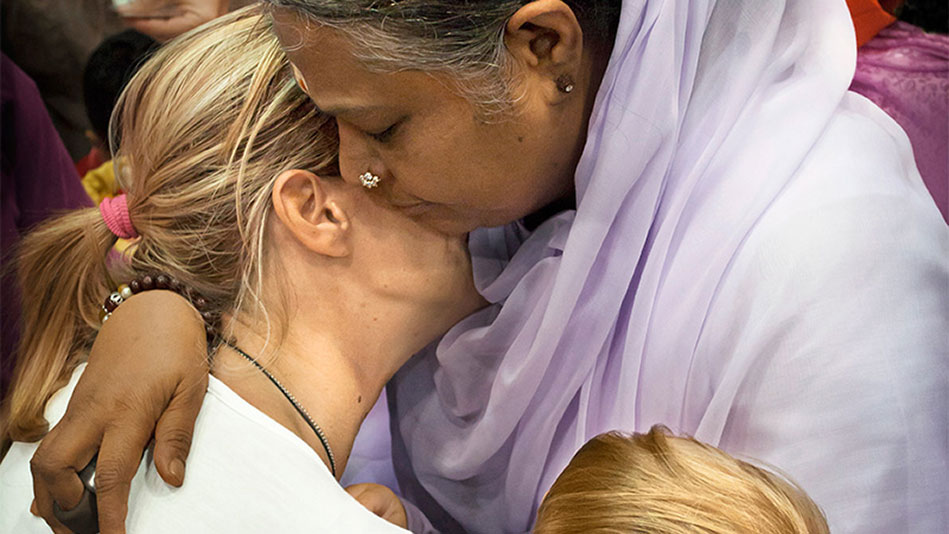
Amma invites us to perceive the divine presence in our closest relationships, urging us to recognize God in our mothers, fathers, and indeed, in everyone we encounter. This profound statement serves as a reminder that the sacred is not confined to temples or scriptures; it permeates the very fabric of our daily interactions. By seeing the divine in others, we cultivate a deeper understanding of love, compassion, and interconnectedness, which are essential for spiritual growth.
In a world often marked by division and misunderstanding, Amma's words resonate with a call to unity and reverence for all beings. This perspective encourages us to transcend superficial judgments and to embrace a more profound, spiritual vision of humanity. It is an invitation to awaken to the divine essence that resides within each person, fostering a sense of belonging and shared purpose in our collective journey toward enlightenment.
The image / the metaphor
At the heart of Amma's quote lies a rich tapestry of imagery that evokes familial love and connection. The act of seeing God in our parents suggests a nurturing relationship, one where the divine is intimately woven into the fabric of our upbringing. The verbs "see" and "everyone" emphasize an active engagement with the world, urging us to look beyond the surface and recognize the sacred in the mundane. This call to perception is not passive; it requires an intentional shift in our awareness, a conscious effort to seek the divine in every interaction.
Diving deeper into the metaphor, we can understand that seeing God in others is an invitation to practice bhakti, or devotion, in our everyday lives. It challenges us to cultivate a heart that is open and receptive, allowing us to experience the divine presence in the laughter of a child, the wisdom of an elder, or the kindness of a stranger. This perspective transforms our relationships, encouraging us to approach each encounter with reverence and love, recognizing that every person is a reflection of the divine light.
In the speaker's tradition
Amma's teachings are deeply rooted in the bhakti tradition, which emphasizes love and devotion as pathways to experiencing the divine. Central to this tradition is the concept of seeing God in all beings, which aligns with the idea of dharma—the moral and ethical duties that guide our interactions with others. By recognizing the divine in everyone, we fulfill our dharma, nurturing compassion and understanding in our relationships. This perspective echoes the teachings of various spiritual traditions, where the essence of unity and interconnectedness is celebrated.
In the Bhagavad Gita, for instance, Krishna speaks of seeing the divine in all creatures, urging Arjuna to recognize the sacredness of life in every form. This aligns with Amma's message, as both emphasize the importance of cultivating a vision that transcends the ego and embraces the oneness of existence. By embodying this teaching, we not only honor our relationships but also contribute to the collective awakening of consciousness, fostering a world rooted in love and understanding.
Living the teaching
Consider a modern scenario where this teaching can be applied: a busy parent juggling work and family responsibilities. In the midst of daily chaos, it can be easy to overlook the divine presence in the simple moments shared with children or partners. By consciously choosing to see God in these interactions—whether it’s in a shared meal, a comforting hug, or a moment of laughter—the parent can transform mundane routines into sacred rituals, deepening their connection with their loved ones and nurturing a sense of gratitude.
Another application of this teaching might arise during a conflict with a friend or colleague. In moments of tension, it is often challenging to see the divine in the other person. However, by pausing to reflect on Amma's words, one can cultivate empathy and understanding, recognizing that beneath the surface of disagreement lies a shared humanity. This practice not only diffuses conflict but also fosters a deeper bond, allowing both parties to grow and learn from the experience.
A reflection
As we contemplate Amma's profound invitation to see God in everyone, we are called to reflect on our own perceptions and interactions. How often do we overlook the divine essence in those around us? In what ways can we cultivate a more compassionate and loving perspective toward others, even in challenging situations? Let this contemplation guide you toward a deeper understanding of the interconnectedness of all beings and the sacredness that resides within each of us.