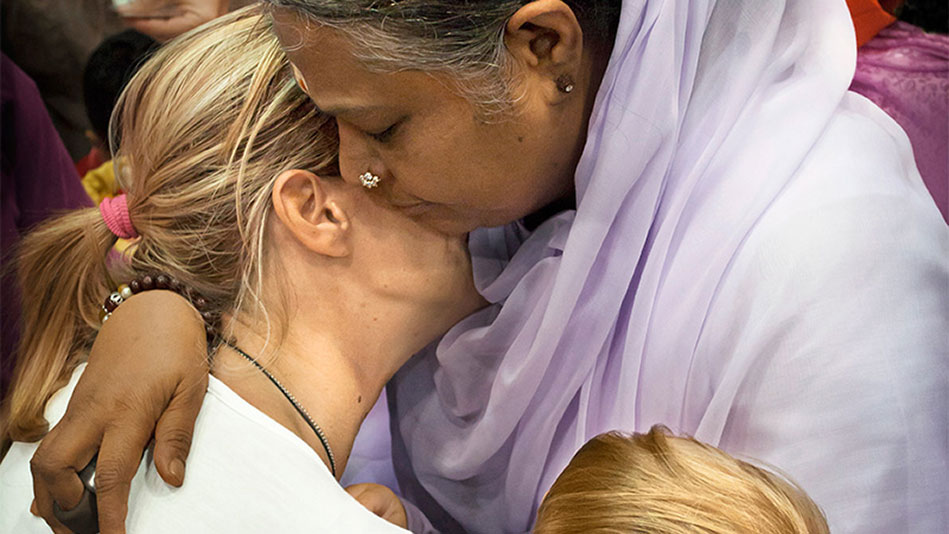
The Blossoming of Love Through Generosity
Amma's profound assertion that "love is the only thing that grows when shared" invites us to reconsider the nature of love itself. In a world often characterized by competition and scarcity, this statement serves as a gentle reminder that love, unlike material possessions, flourishes when we extend it to others. The stakes are high; understanding this principle can transform our relationships, our communities, and ultimately, ourselves. It challenges us to embrace a mindset of abundance rather than one of lack, urging us to cultivate connections that enrich our lives and the lives of those around us.
Delving deeper, we find that this quote encapsulates a fundamental truth about human existence: love is inherently relational. It is not a solitary experience but a dynamic force that thrives in the act of giving. When we share love, we create a ripple effect that not only nurtures the recipient but also nourishes our own hearts. This reciprocal exchange fosters a sense of belonging and interconnectedness, reminding us that we are all part of a larger tapestry of life. In this light, Amma's words become a call to action, inviting us to engage in acts of love that transcend our individual experiences and contribute to a collective flourishing.
The image / the metaphor
At first glance, the imagery in Amma's quote evokes a garden where love is the seed that, when shared, blossoms into a vibrant array of colors and fragrances. The verbs "grows" and "shared" are particularly poignant; they suggest an active process rather than a passive state. Love, in this context, is not merely a feeling to be hoarded but a living entity that requires nurturing through interaction and generosity. The act of sharing becomes a catalyst for growth, transforming love from a solitary experience into a communal celebration.
Going deeper into the metaphor, we can see that love's growth is akin to the way a tree expands its branches, reaching outwards to embrace the sky while simultaneously providing shelter and nourishment to those beneath it. This image invites us to reflect on the interconnectedness of all beings; just as a tree thrives in a forest, so too does love flourish in a community. The more we share our love, the more it multiplies, creating a network of support and understanding that enriches the lives of everyone involved. In this way, love becomes a shared resource, a wellspring that sustains us all.
In the speaker's tradition
Amma's teachings are deeply rooted in the bhakti tradition, which emphasizes devotion and love as pathways to spiritual realization. Central to this tradition is the concept of *bhakti*, or loving devotion, which encourages practitioners to cultivate a heartfelt connection with the divine and with one another. This notion aligns beautifully with Amma's assertion; as we share our love, we engage in a form of *seva*, or selfless service, that not only benefits others but also deepens our own spiritual journey. In this context, love is not just an emotion but a sacred duty, a practice that leads us toward greater awareness and connection.
Moreover, the idea of love growing through sharing resonates with the Buddhist concept of *sunyata*, or emptiness, which teaches that our identities and experiences are interdependent. Just as love expands when shared, so too does our understanding of ourselves and our place in the world. In the *Bhagavad Gita*, Krishna speaks of the importance of selfless action, reinforcing the idea that true fulfillment comes not from what we possess but from what we give. This interconnectedness is a cornerstone of both bhakti and other spiritual traditions, highlighting the universal truth that love, when shared, becomes a transformative force.
Living the teaching
Consider a modern scenario where this teaching can take root: a community meal organized to support those in need. In this act of sharing food, love is not only present but palpable, as individuals come together to contribute their time, resources, and compassion. Each dish prepared and shared becomes a vessel of love, nourishing not just the body but also the spirit of connection among participants. In this way, the act of sharing transcends the mere exchange of food; it becomes a celebration of community, reinforcing the idea that love grows exponentially when we engage in collective acts of kindness.
Another application of this teaching can be found in personal relationships, particularly during challenging moments. Imagine a disagreement between friends where misunderstandings have created distance. By choosing to share love through open communication and vulnerability, both individuals can begin to heal the rift. This act of sharing—whether it be through listening, apologizing, or simply being present—can lead to a deeper understanding and a renewed bond. In this context, love becomes a bridge, allowing both parties to grow together rather than apart, illustrating Amma's wisdom that love flourishes when it is freely given.
A reflection
As we contemplate Amma's profound statement, we are invited to reflect on our own lives: How can we cultivate a spirit of sharing in our relationships and communities? What small acts of love can we initiate that might lead to greater connection and understanding? By engaging with these questions, we open ourselves to the possibility of love's transformative power, allowing it to grow and flourish in ways we may not have previously imagined.