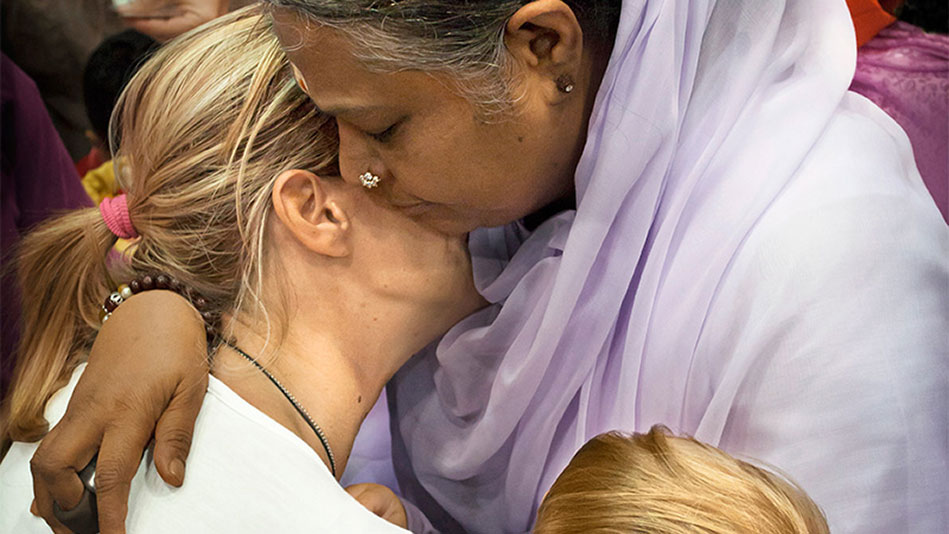
Amma invites us to engage in a profound form of prayer, one that transcends mere words and rituals. "Pray with your heart. The heart speaks the language of God." This statement emphasizes the importance of sincerity and emotional depth in our spiritual practices. It suggests that true communication with the divine occurs not through the intellect or external forms, but through the heartfelt expression of our innermost selves. In a world often dominated by superficial interactions, this teaching serves as a reminder of the transformative power of authentic connection.
Delving deeper, we find that the heart is not merely an organ but a symbol of our emotional and spiritual essence. When Amma speaks of the heart's language, she points to a mode of communication that is intuitive, direct, and deeply personal. This approach to prayer invites us to shed our defenses and engage with the divine from a place of vulnerability and openness. It challenges us to consider how often we approach spirituality with our minds rather than our hearts, and what we might discover if we allowed our emotions to guide our prayers.
The image / the metaphor
The imagery in Amma's quote evokes a sense of intimacy and immediacy. The heart, often associated with love and compassion, is portrayed as a conduit for divine communication. The verbs "pray" and "speak" suggest an active engagement, a dynamic relationship rather than a passive one. This metaphor invites us to envision prayer as a dialogue, where our heartfelt expressions resonate with the divine, creating a sacred space for connection and understanding.
In the speaker's tradition
Amma's teachings are deeply rooted in the bhakti tradition, which emphasizes devotion and love for the divine. In bhakti, the heart is central to spiritual practice, as it is through love and devotion that one can experience a profound connection with God. Concepts such as dharma (righteousness) and bhakti (devotional love) intertwine, suggesting that living in alignment with one's heart leads to a deeper understanding of one's purpose and relationship with the divine. This tradition teaches that surrendering the ego and opening the heart can lead to a state of kenosis, or self-emptying, allowing divine love to flow through us.
In the Bhagavad Gita, a foundational text in the bhakti tradition, Lord Krishna emphasizes the importance of devotion and surrender. He states, "Whatever you do, do it as an offering to Me" (Bhagavad Gita 3:19). This aligns with Amma's teaching, as it encourages us to approach our actions and prayers with a heart full of love and intention. The Gita invites us to see our lives as a continuous act of devotion, where every thought and action can be a prayer when infused with love.
Living the teaching
Consider a modern scenario where this teaching can be applied: a person grappling with anxiety before a significant life event, such as a job interview or a public speaking engagement. Instead of relying solely on rehearsed lines or intellectual preparation, they might take a moment to center themselves, placing their hand over their heart and allowing their feelings of fear and hope to surface. In this moment of vulnerability, they can transform their anxiety into a heartfelt prayer, asking for guidance and clarity. This practice not only calms the mind but also opens the heart to receive divine support.
In relationships, the heart's language can be equally transformative. Imagine a couple facing a difficult conversation, perhaps about a recurring conflict. Instead of approaching the dialogue with defensiveness or blame, they could choose to express their feelings from the heart, sharing their vulnerabilities and fears. By doing so, they create a space for empathy and understanding, allowing their love to guide the conversation. This practice of heartfelt communication fosters deeper connections and nurtures the relationship, embodying Amma's teaching in a tangible way.
A reflection
As we contemplate Amma's profound words, we are invited to reflect on our own relationship with prayer and the divine. How often do we engage in prayer from a place of genuine emotion, rather than obligation or routine? In what ways can we cultivate a deeper connection with our hearts, allowing them to guide our spiritual practices? Consider these questions as you navigate your own spiritual journey, and let the heart's language resonate within you.