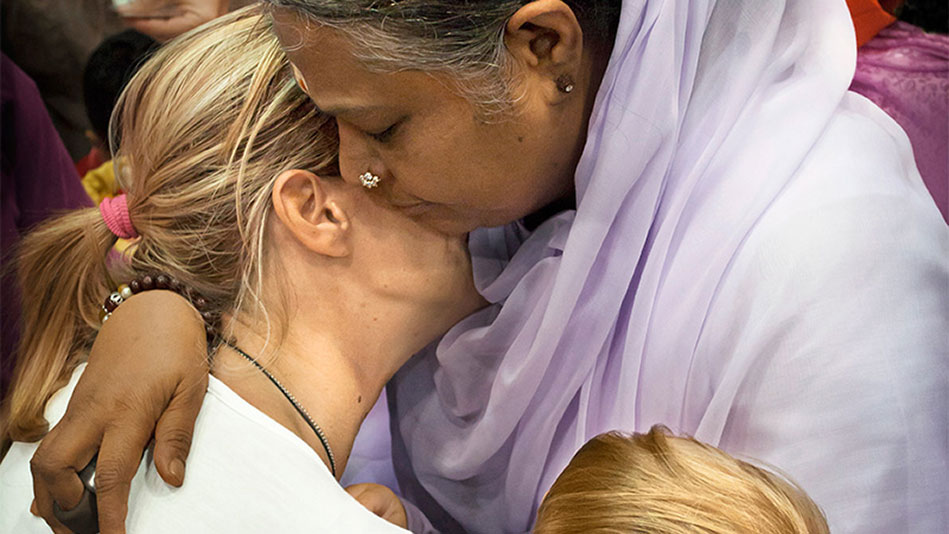
The Divine Gaze of Love
Amma, the revered spiritual teacher, offers a profound insight with her statement, "The Mother sees you with the eyes of love." This quote encapsulates the essence of unconditional love and acceptance that characterizes the divine maternal presence. It invites us to reflect on how we perceive ourselves and others through the lens of love, rather than judgment or fear. In a world often clouded by negativity and self-doubt, this perspective becomes a beacon of hope, urging us to embrace our true nature as beloved children of the Divine.
Delving deeper, we recognize that the phrase "the eyes of love" is not merely poetic; it signifies a transformative way of seeing that transcends ordinary perception. It suggests a vision that perceives the inherent goodness and potential within each individual, regardless of their flaws or circumstances. This loving gaze fosters a sense of belonging and acceptance, reminding us that we are never alone in our struggles. By embodying this divine perspective, we can cultivate compassion for ourselves and others, ultimately leading to a more harmonious existence.
The image / the metaphor
The imagery in Amma's quote evokes a nurturing presence, akin to that of a mother who gazes upon her child with unwavering love and tenderness. The verb "sees" implies an active engagement, suggesting that this divine vision is not passive but rather a conscious choice to perceive the world through a lens of affection. This act of seeing becomes a powerful metaphor for how we can choose to view ourselves and those around us. It invites us to shift our focus from the surface-level judgments that often cloud our interactions to a deeper understanding rooted in love.
Moreover, the metaphor of "the eyes of love" speaks to the transformative power of perception. When we see through the eyes of love, we begin to recognize the interconnectedness of all beings. This perspective aligns with the bhakti tradition, where love is not just an emotion but a pathway to divine union. By embracing this vision, we can transcend the barriers that separate us, fostering a sense of unity and compassion that is essential for spiritual growth.
In the speaker's tradition
Amma's teachings are deeply rooted in the bhakti tradition, which emphasizes devotion and love as the primary means of connecting with the Divine. In this context, the concept of "dharma" plays a crucial role, as it encourages individuals to live in alignment with their true nature and purpose. The act of seeing through the eyes of love can be understood as a form of "kenosis," or self-emptying, where one relinquishes ego-driven perceptions in favor of a more expansive, loving view of reality. This aligns with the notion of "sunyata," or emptiness, which invites us to let go of preconceived notions and judgments, allowing love to fill the space instead.
In the sacred texts of the bhakti tradition, we find echoes of this teaching. For instance, in the writings of Mirabai, a celebrated devotee of Krishna, we see a similar emphasis on the transformative power of love. Her poetry often reflects a deep yearning for the divine gaze, illustrating how this loving perception can lead to profound spiritual awakening. By situating Amma's quote within this rich tradition, we can appreciate its depth and significance as a call to embody love in our daily lives.
Living the teaching
Consider a modern scenario where this teaching can be applied: a workplace conflict where misunderstandings and tensions run high. In such situations, the challenge often lies in how we perceive our colleagues. By consciously choosing to see them through the eyes of love, we can foster an environment of empathy and understanding. This shift in perception can transform the dynamics of the workplace, allowing for more constructive communication and collaboration. When we approach others with compassion, we create space for healing and reconciliation, reflecting the divine love that Amma speaks of.
Another application of this teaching can be found in personal relationships, particularly during difficult moments. Imagine a disagreement with a loved one, where emotions run deep and hurt feelings abound. By invoking the perspective of "the Mother sees you with the eyes of love," we can remind ourselves to look beyond the immediate conflict and recognize the shared humanity in each other. This practice not only diffuses tension but also nurtures a deeper connection rooted in understanding and acceptance. In daily life, cultivating this vision can transform our interactions, allowing love to guide our responses rather than fear or anger.
A reflection
As we contemplate Amma's profound statement, we are invited to ask ourselves: How can I cultivate the ability to see myself and others through the eyes of love? This question encourages a deep introspection, prompting us to examine our perceptions and judgments. In a world that often emphasizes criticism and division, embracing this divine perspective can be a radical act of compassion. By committing to this practice, we not only honor the teachings of Amma but also contribute to a more loving and connected world.