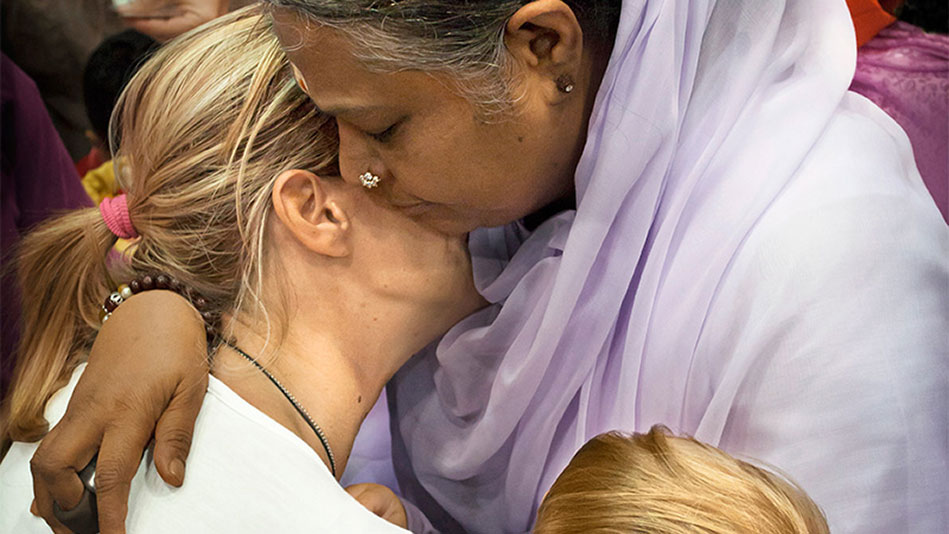
Amma's profound assertion, "To love an enemy is the highest love," invites us to explore the depths of compassion and the transformative potential of love in the face of adversity. This statement challenges our conventional understanding of love, urging us to extend our hearts even to those who may oppose or harm us. In a world often divided by conflict and animosity, this teaching holds significant relevance, reminding us that true love transcends personal grievances and societal boundaries.
At its core, this quote beckons us to reconsider our relationships with those we perceive as adversaries. It suggests that the highest form of love is not merely reserved for friends or family but is a radical act of embracing even those who challenge us. This perspective not only elevates our understanding of love but also serves as a call to action, inviting us to cultivate a heart that can encompass all beings, regardless of their actions or intentions.
The image / the metaphor
When Amma speaks of loving an enemy, she employs powerful imagery that evokes a sense of struggle and triumph. The term "enemy" conjures feelings of resistance, fear, and division, while "love" embodies warmth, acceptance, and unity. The juxtaposition of these two concepts creates a vivid landscape where the act of loving becomes a courageous endeavor, a journey that requires us to confront our own biases and fears. The verbs chosen—"to love"—imply an active engagement, a deliberate choice to extend compassion even when it feels most difficult.
Diving deeper into this metaphor, we can see that loving an enemy is not about condoning harmful actions or ignoring injustices; rather, it is about recognizing the shared humanity that exists beneath the surface. This love is akin to a balm that soothes the wounds of division, transforming animosity into understanding. It invites us to see beyond the labels we assign to others and to acknowledge the interconnectedness of all beings, a theme that resonates deeply within the bhakti tradition.
In the speaker's tradition
Amma's teaching is deeply rooted in the bhakti tradition, which emphasizes devotion and love as pathways to spiritual realization. Central to this tradition is the concept of "bhakti" itself, which signifies a selfless love that transcends personal attachments and embraces all beings. This notion aligns closely with the idea of "kenosis," or self-emptying, where one relinquishes the ego to allow divine love to flow through them. In this context, loving an enemy becomes a profound act of devotion, a way to embody the divine qualities of compassion and forgiveness.
Moreover, this teaching echoes the principles found in various spiritual texts, such as the Bhagavad Gita, where Krishna advises Arjuna to act with equanimity towards friends and foes alike. The Gita emphasizes the importance of seeing all beings as equal, urging us to cultivate a heart that remains steadfast in love, regardless of external circumstances. This alignment with ancient wisdom underscores the timeless nature of Amma's message, inviting us to engage in a practice that fosters unity and understanding.
Living the teaching
Consider a modern scenario where this teaching can be applied: a workplace conflict where two colleagues find themselves at odds. Instead of allowing resentment to fester, one might choose to approach the situation with an open heart, seeking to understand the underlying motivations of the other. By extending compassion and engaging in dialogue, the potential for reconciliation emerges, transforming a hostile environment into one of collaboration and mutual respect. This act of loving an enemy not only benefits the individuals involved but also contributes to a more harmonious workplace culture.
Another application of this teaching can be found in personal relationships, particularly during moments of disagreement or hurt. Imagine a situation where a loved one has caused pain through their words or actions. Instead of responding with anger or withdrawal, one can practice the art of forgiveness, recognizing that love is not contingent upon perfection. By choosing to love despite the hurt, we create space for healing and growth, allowing the relationship to evolve into something deeper and more resilient.
A reflection
As we contemplate Amma's profound statement, we are invited to reflect on our own capacity for love in challenging situations. How can we cultivate a heart that embraces even those we find difficult to love? In what ways can we practice extending compassion to our perceived enemies, transforming our relationships and, ultimately, ourselves? This inquiry invites us to explore the boundaries of our love and to consider the transformative power that lies in embracing the unlovable.