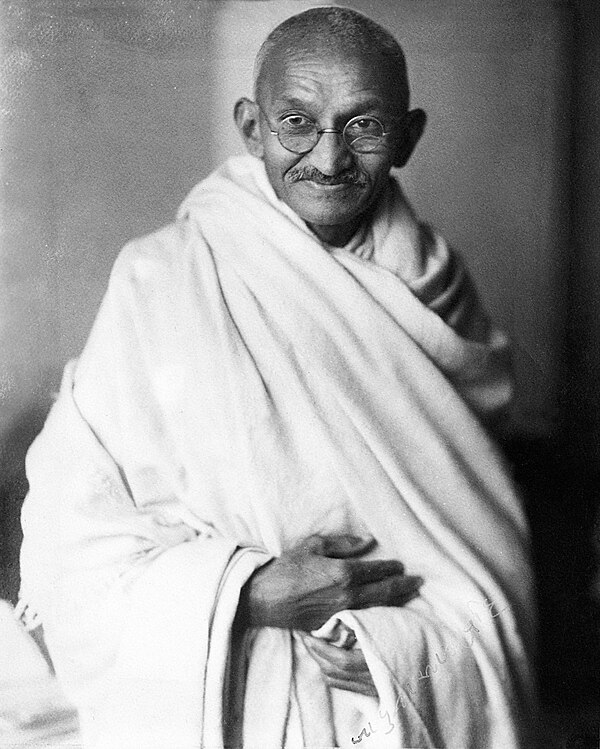
The Essence of Self-Rule: A Collective Awakening
Mahatma Gandhi's assertion that "Swaraj of a people means the sum total of the swaraj (self-rule) of individuals" invites us to reconsider the nature of freedom and responsibility within a community. At its core, this statement emphasizes that true autonomy is not merely a political concept but a deeply personal one, rooted in the self-governance of each individual. The stakes are high; understanding this relationship between individual and collective self-rule can illuminate pathways to genuine freedom, both personally and socially.
In a world often characterized by external conflicts and power struggles, Gandhi's words remind us that the liberation of a society is intrinsically linked to the inner liberation of its members. This perspective challenges us to reflect on our own roles within larger systems, urging us to cultivate self-awareness and responsibility. The journey toward swaraj is not just about resisting oppression; it is about nurturing the inner landscape of each person, fostering a community where each individual thrives in their autonomy and contributes to the collective good.
The image / the metaphor
The imagery in Gandhi's quote evokes a tapestry woven from countless threads, each representing an individual’s capacity for self-rule. The verbs "means" and "sum total" suggest a mathematical precision, indicating that the strength of a community is directly proportional to the strength of its individuals. This metaphor of interconnectedness highlights that the health of a society cannot be separated from the well-being of its members; each person's self-governance contributes to a larger narrative of freedom.
Diving deeper into this metaphor, we can see that swaraj is not merely a political state but a spiritual and ethical condition. It implies a profound responsibility to oneself and to others, suggesting that individual autonomy must be exercised with awareness and compassion. The image of a collective consciousness emerges, where the flourishing of one enhances the flourishing of all, creating a harmonious balance that is essential for true freedom.
In the speaker's tradition
Furthermore, Gandhi's emphasis on self-rule can be seen in the context of the Bhagavad Gita, where Arjuna's struggle with duty and righteousness mirrors the internal conflicts we all face. The Gita teaches that true action arises from a place of inner clarity and self-awareness, reinforcing the idea that individual self-governance is essential for the collective well-being. In this way, Gandhi's vision of swaraj is deeply rooted in the spiritual teachings of his tradition, calling for a harmonious balance between personal autonomy and communal responsibility.
Living the teaching
Consider a modern scenario where this teaching manifests: a community grappling with environmental issues. Each individual’s commitment to sustainable practices—be it reducing waste, conserving energy, or advocating for policy changes—contributes to the collective health of the environment. Here, the concept of swaraj becomes tangible; as individuals take responsibility for their actions, they collectively shape a more sustainable future. This illustrates how personal choices can ripple outward, impacting the broader community and environment.
In a more intimate context, think about relationships. When individuals within a partnership practice self-rule—honoring their own needs, desires, and boundaries—they create a space for mutual respect and understanding. This dynamic fosters a relationship where both partners can thrive, illustrating that self-governance is not only a political ideal but a relational necessity. By embodying swaraj in our interactions, we cultivate deeper connections rooted in authenticity and respect.
A reflection
As we contemplate Gandhi's profound insight, we might ask ourselves: "In what ways can I cultivate my own self-rule to contribute to the greater good of my community?" This question invites introspection, encouraging us to explore how our individual actions and choices resonate within the larger tapestry of society. By reflecting on our personal responsibilities, we can begin to understand the interconnectedness of our lives and the impact we have on the world around us.


