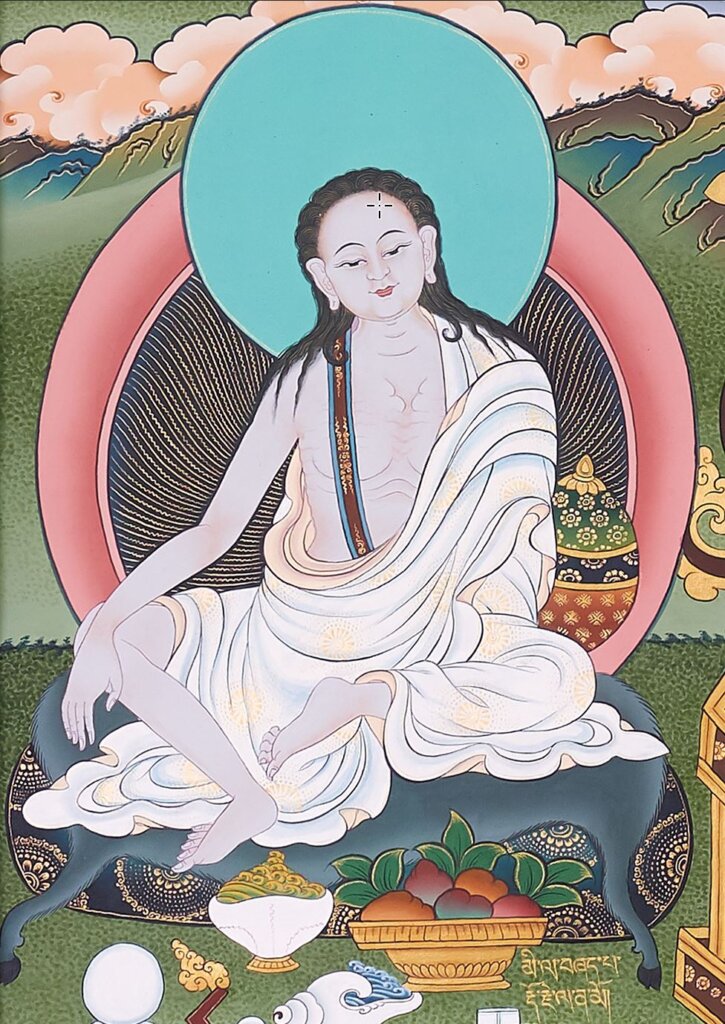
The Dissolution of Distinctions: A Journey into Non-Duality
Milarepa's profound assertion, "In meditation, all distinctions dissolve," invites us into a realm where the boundaries that typically define our existence begin to blur. This statement encapsulates a transformative experience, one that transcends the dualities of self and other, subject and object. In a world often characterized by division and separation, understanding this dissolution becomes essential for those seeking deeper spiritual insight and connection. It beckons us to explore the nature of reality and our place within it, urging us to look beyond the surface of our everyday experiences.
As we delve into the heart of this quote, we recognize that it speaks to the essence of meditation itself—a practice that encourages us to quiet the mind and turn inward. In this stillness, we encounter the possibility of letting go of our preconceived notions and the rigid categories that shape our perceptions. The journey into meditation is not merely a retreat from the chaos of life; it is an invitation to engage with the very fabric of existence, where the illusion of separation fades and a profound sense of unity emerges. This exploration is not just theoretical; it has practical implications for how we relate to ourselves and the world around us.
The image / the metaphor
At its core, Milarepa's quote conjures an image of a vast, boundless ocean where the distinctions of waves, currents, and depths dissolve into a singular experience of water. The verbs "dissolve" and "meditation" evoke a sense of fluidity and transformation, suggesting that through the practice of meditation, we can experience a state of being that transcends our usual categorizations. This imagery resonates deeply with the experience of letting go—of relinquishing the tight grip of identity and the labels we often cling to in our daily lives.
Delving deeper into this metaphor, we can liken the process of meditation to the melting of ice into water. Just as ice appears solid and distinct, so too do our thoughts and identities seem fixed and separate. However, in the warmth of contemplative practice, these distinctions begin to soften and ultimately dissolve, revealing the underlying essence of our shared existence. This metaphor serves as a reminder that beneath the surface of our individual experiences lies a profound interconnectedness, waiting to be realized through the practice of meditation.
In the speaker's tradition
Milarepa, a revered figure in Tibetan Buddhism, embodies the principles of non-duality and the transformative power of meditation. His teachings resonate with the concept of *sunyata*, or emptiness, which posits that all phenomena are devoid of inherent existence. This understanding encourages practitioners to see beyond the dualistic nature of reality, recognizing that distinctions such as self and other are ultimately constructs of the mind. In this light, Milarepa's assertion becomes a call to awaken to the truth of our interconnectedness, a theme that permeates the teachings of the Buddha and the broader Buddhist tradition.
In the *Songs of Milarepa*, we find echoes of this non-dual perspective, where the practitioner is urged to transcend the limitations of ordinary perception. The *Heart Sutra*, a foundational text in Mahayana Buddhism, similarly emphasizes the notion that form is emptiness and emptiness is form, reinforcing the idea that our distinctions are mere illusions. By situating Milarepa's quote within this rich tapestry of Buddhist thought, we can appreciate the depth of his insight and the transformative potential of meditation as a means to dissolve the barriers that separate us from our true nature.
Living the teaching
Consider a modern scenario where the teaching of Milarepa's quote might resonate: a heated discussion between friends about a contentious issue. In the heat of the moment, each person may become entrenched in their viewpoint, perceiving the other as an adversary. However, if one were to pause and engage in a moment of meditation—perhaps taking a few deep breaths and centering themselves—they might begin to recognize that their differences are not as insurmountable as they seem. This moment of stillness can create space for empathy and understanding, allowing the distinctions that divide them to dissolve, if only temporarily.
Another application of this teaching can be found in the realm of personal relationships. Imagine a couple facing a conflict, each feeling misunderstood and isolated in their perspectives. By embracing the practice of meditation together, they can cultivate a shared space of awareness, where the rigid boundaries of "you" and "me" begin to soften. In this shared silence, they may discover a deeper connection that transcends their differences, fostering compassion and a renewed sense of unity. In both scenarios, the act of meditation serves as a bridge, facilitating the dissolution of distinctions and inviting a more profound understanding of one another.
A reflection
As we contemplate Milarepa's assertion, we are invited to reflect on the nature of our own distinctions. What barriers do we create in our lives that separate us from others? In what ways might we benefit from the practice of meditation to dissolve these divisions and cultivate a deeper sense of connection? These questions encourage us to engage with the teachings of non-duality and to explore the transformative potential of our inner landscapes, inviting us to embrace the unity that lies beneath the surface of our everyday experiences.
