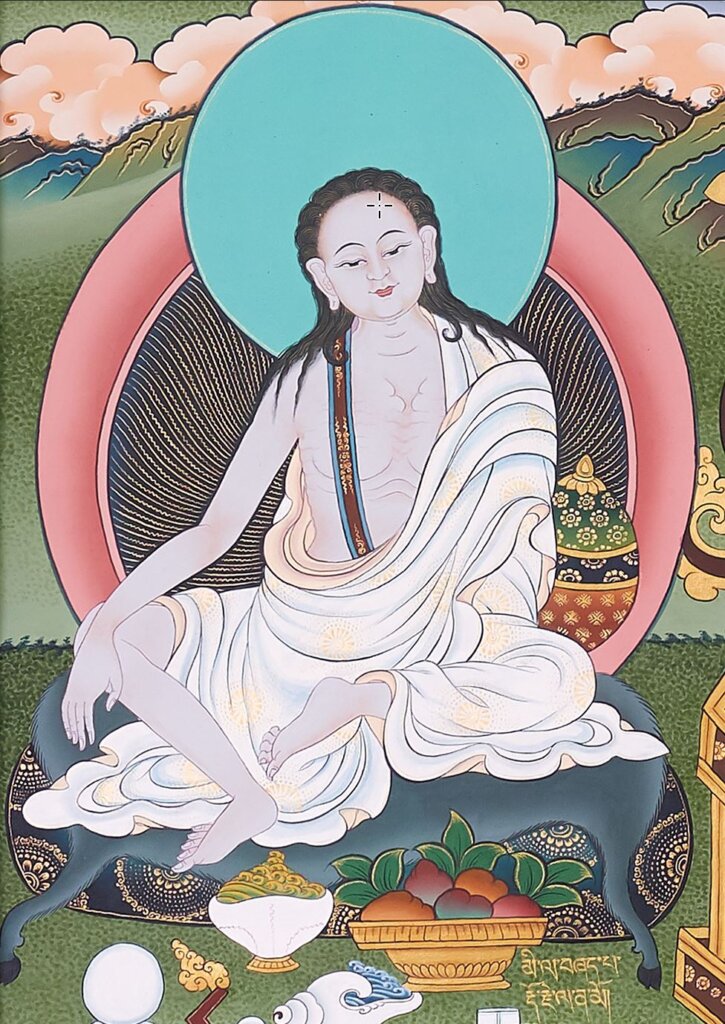
Milarepa's poignant exhortation, "In the bardo of living, do not cling," invites us to explore the delicate balance between engagement and detachment in our daily lives. The term "bardo," often associated with the transitional state between death and rebirth in Tibetan Buddhism, here signifies the ephemeral nature of existence itself. This quote serves as a reminder that our experiences, emotions, and attachments are transient, and clinging to them can lead to suffering. Understanding this teaching is crucial, as it encourages us to navigate life with a sense of openness and fluidity, rather than being ensnared by our desires and fears.
In a world that often promotes attachment—whether to material possessions, relationships, or even our own identities—Milarepa's wisdom resonates deeply. The act of clinging can manifest as a desperate grasping for permanence in an impermanent world, leading to anxiety and discontent. By embracing the concept of non-clinging, we can cultivate a more profound sense of peace and acceptance, allowing ourselves to experience life fully without the weight of attachment. This teaching invites us to engage with the present moment, recognizing its beauty and transience, and to let go of the need to control or possess what is inherently fleeting.
The image / the metaphor
The imagery of "the bardo of living" evokes a vivid sense of transition and impermanence. In Tibetan Buddhism, the bardo is a liminal space, a threshold where one exists between two states of being. By framing life itself as a bardo, Milarepa highlights the transient nature of our experiences. The verb "cling" suggests a gripping, a holding on that can lead to suffering, while the absence of clinging opens the door to freedom and liberation. This metaphor invites us to visualize life as a river, flowing and changing, where our attachments act as stones that disrupt the current.
Diving deeper into this metaphor, we can see how clinging can create turbulence in our lives. Just as a river can become choked with debris, our minds can become cluttered with attachments that hinder our spiritual progress. The act of non-clinging, then, becomes a practice of clearing the riverbed, allowing the waters of life to flow freely. In this way, Milarepa's teaching encourages us to embrace the fluidity of existence, to dance with the currents rather than resist them, and to find joy in the ever-changing landscape of our lives.
In the speaker's tradition
Milarepa's teachings are deeply rooted in the Tibetan Buddhist tradition, where concepts such as dharma and sunyata (emptiness) play a pivotal role. The notion of non-clinging aligns with the Buddhist understanding of impermanence (anicca) and the realization that all phenomena are transient. This perspective encourages practitioners to cultivate a sense of detachment from the self and the material world, recognizing that clinging leads to suffering. In this context, non-clinging is not about renunciation but rather about engaging with life fully while understanding its ephemeral nature.
In the "Songs of Milarepa," we find echoes of this teaching in the emphasis on the importance of meditation and mindfulness. Milarepa's life exemplifies the practice of letting go, as he transformed his past suffering into wisdom through rigorous spiritual practice. His songs often reflect the realization that true liberation comes from understanding the nature of reality, which includes the acceptance of impermanence and the relinquishing of attachment. This aligns with the teachings found in the Heart Sutra, which proclaims the essence of emptiness, urging us to see beyond the illusions of clinging and grasping.
Living the teaching
Consider a modern scenario where this teaching can be applied: the experience of loss. When we lose a loved one, the natural inclination is to cling to memories, to hold on to the past, and to resist the reality of change. This clinging can lead to profound grief and suffering. However, by embracing Milarepa's wisdom, we can learn to honor our memories while also allowing ourselves to move forward. This does not mean forgetting; rather, it means recognizing that life continues to unfold, and that our loved ones would want us to find joy and meaning in the present.
Another application of this teaching can be found in relationships. Often, we may cling to expectations or ideals about how our relationships should be, leading to disappointment and conflict. By practicing non-clinging, we can approach our relationships with openness and acceptance, allowing them to evolve naturally. This shift in perspective fosters deeper connections, as we learn to appreciate our partners for who they are, rather than who we wish them to be. In this way, Milarepa's teaching encourages us to cultivate a sense of freedom and joy in our interactions, letting go of the need to control and embracing the beauty of impermanence.
A reflection
As we contemplate Milarepa's profound teaching, we are invited to reflect on our own lives and the attachments we hold. What are the areas in which we find ourselves clinging too tightly? How might our experiences shift if we were to embrace the fluidity of existence and practice non-clinging? In this moment of reflection, let us consider how we can cultivate a deeper sense of presence and acceptance in our daily lives, allowing the currents of life to guide us rather than confining us to the shores of attachment.
