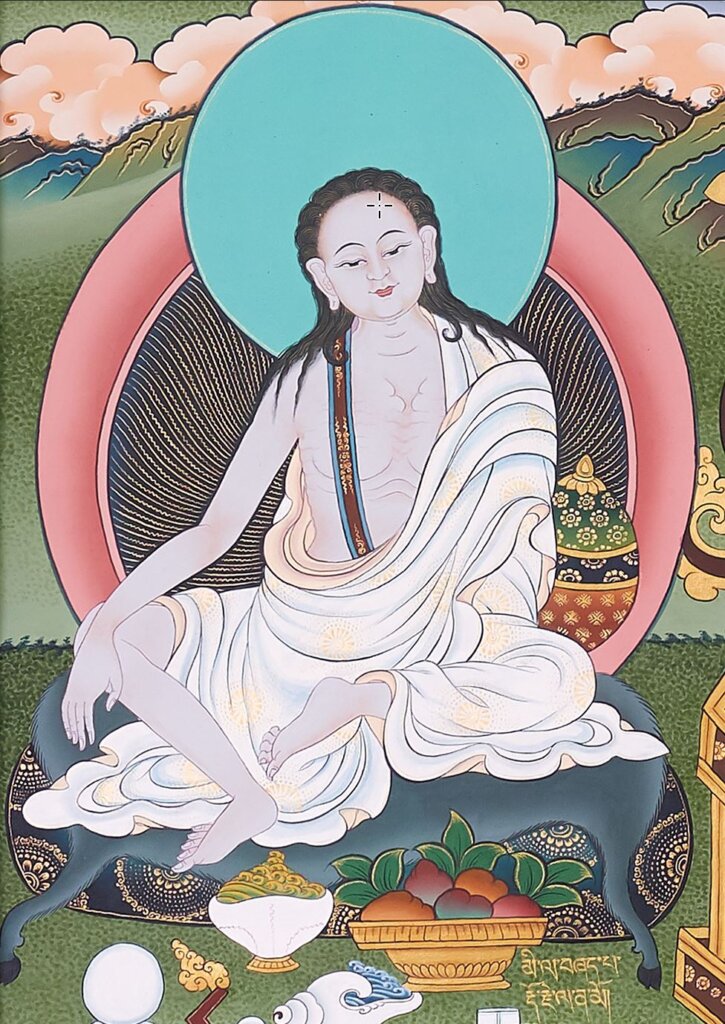
The Oneness of Being: A Journey Beyond Duality
Milarepa's profound assertion, "Self and other become one," invites us to explore the intricate relationship between our individual identities and the world around us. This statement is not merely a philosophical observation; it is a call to transcend the boundaries that separate us from others. In a time when division often dominates our social landscape, understanding this unity becomes essential for fostering compassion and empathy in our interactions.
To grasp the depth of Milarepa's insight, we must recognize that this unity is not a loss of self, but rather an expansion of consciousness. It challenges the conventional understanding of identity, urging us to see beyond the illusion of separateness. In doing so, we open ourselves to a more profound experience of connection, where the distinction between self and other dissolves, revealing the underlying fabric of existence that binds us all.
The image / the metaphor
At its core, the phrase "Self and other become one" evokes a vivid imagery of merging identities, where the boundaries that typically define us begin to blur. The verb "become" suggests a dynamic process, indicating that this unity is not a static state but an evolving realization. The felt sense of this experience is akin to standing at the edge of a vast ocean, where the waves of individual consciousness intermingle, creating a singular, flowing entity that transcends the limitations of the shore.
Diving deeper into the metaphor, we can envision the self as a drop of water, distinct yet part of the greater ocean. Each drop carries its own unique characteristics, yet when it merges with the ocean, it contributes to a larger whole. This imagery encapsulates the essence of interconnectedness, reminding us that while we may perceive ourselves as separate entities, we are ultimately part of a grander tapestry of life. The realization of this unity can evoke a sense of liberation, as we let go of the burdens of isolation and embrace the collective experience of being.
In the speaker's tradition
Milarepa, a revered figure in Tibetan Buddhism, embodies the principles of dharma and the pursuit of enlightenment through the realization of non-duality. His teachings resonate with the concept of sunyata, or emptiness, which posits that all phenomena are interdependent and devoid of inherent existence. This understanding invites practitioners to dissolve the rigid boundaries of self and other, fostering a sense of compassion that extends beyond personal attachments.
In the context of Milarepa's life and teachings, we can draw parallels to the notion of kenosis, or self-emptying, found in various spiritual traditions. Just as kenosis invites individuals to relinquish their ego-driven desires, Milarepa's call to unity encourages us to transcend our limited perceptions. The Tibetan Book of the Dead, a significant text in the Buddhist tradition, further illustrates this concept by emphasizing the importance of recognizing the illusory nature of the self, ultimately guiding practitioners toward the realization of their interconnectedness with all beings.
Living the teaching
Consider a modern scenario where the teaching of unity manifests in a workplace setting. Imagine a team grappling with a challenging project, where individual egos clash and competition stifles collaboration. By embracing the idea that "self and other become one," team members can shift their focus from personal agendas to a collective goal. This transformation fosters an environment of mutual support, where each person's strengths contribute to the success of the whole, illustrating the power of unity in overcoming obstacles.
In a more personal context, this teaching can be applied within relationships, particularly during moments of conflict. When disagreements arise, the tendency is often to view the other as an adversary. However, by recognizing that the essence of our being is intertwined, we can approach the situation with empathy and understanding. This shift in perspective allows for deeper connections, as we begin to see the other not as separate but as a reflection of ourselves, ultimately leading to resolution and harmony.
A reflection
As we contemplate Milarepa's profound statement, we are invited to explore the nature of our own relationships and interactions. How might our lives transform if we genuinely embraced the idea that "self and other become one"? This question encourages us to reflect on our perceptions of separateness and to consider the ways in which we can cultivate a deeper sense of unity in our daily lives. In this exploration, we may discover the profound interconnectedness that lies at the heart of our shared human experience.
