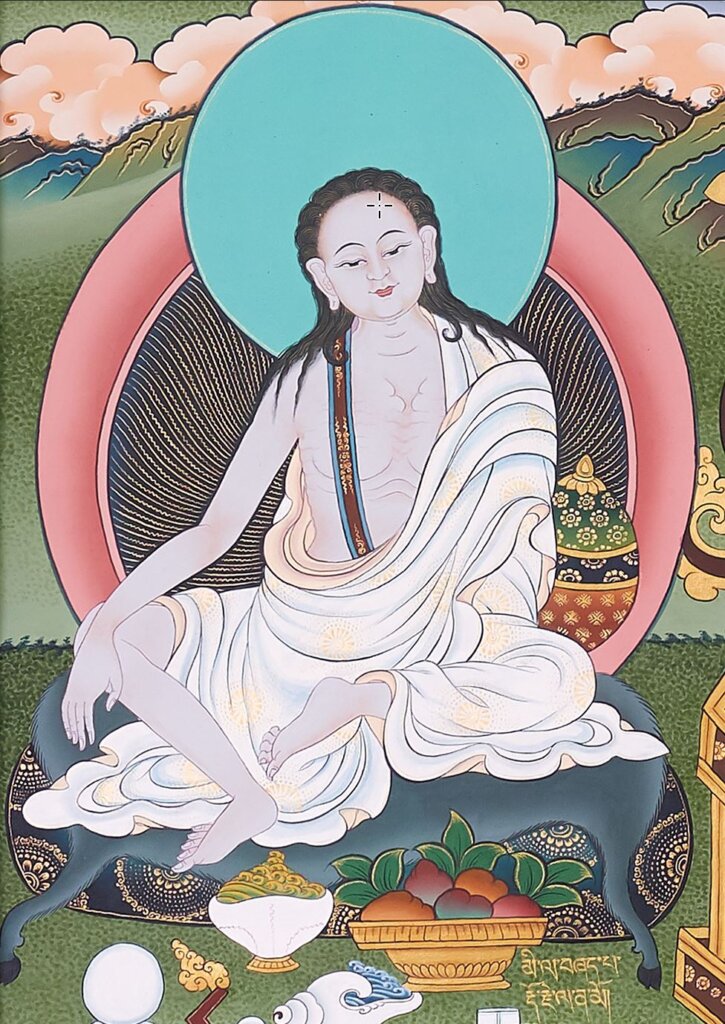
Milarepa's profound statement, "Sit before it long enough — it whispers the dharma," invites us into a contemplative space where silence becomes a teacher. In this quote, the act of sitting—of being present and patient—opens the door to deeper understanding and insight. The stakes are high in our fast-paced world, where distractions abound and the noise of daily life often drowns out the subtle messages of wisdom. To truly hear the whispers of the dharma, we must cultivate the stillness necessary to listen, allowing the teachings to unfold in their own time.
This invitation to sit and listen is not merely a call to physical stillness but a deeper engagement with the essence of our being. It suggests that the dharma, or the truth of existence, is not something to be grasped through intellectual pursuit alone. Instead, it is revealed in the quiet moments of reflection and contemplation. Milarepa, a revered figure in Tibetan Buddhism, embodies this practice, having transformed his life through deep meditation and connection with the natural world. His words remind us that wisdom often emerges from the silence we create within ourselves.
The image / the metaphor
The imagery in Milarepa's quote evokes a serene landscape, perhaps a mountain, where one can sit in solitude and stillness. The verb "sit" suggests a grounding, a rooting into the earth, while "whispers" conveys a gentle, almost elusive quality of the dharma. This juxtaposition of action and passivity highlights the paradox of spiritual practice: we must actively engage in stillness to receive the teachings that are always present yet often overlooked. The act of sitting becomes a sacred ritual, a way to honor the space where insight can arise.
In the speaker's tradition
Milarepa's teachings are deeply rooted in the Tibetan Buddhist tradition, where the concepts of dharma and meditation are central to spiritual practice. The dharma, often understood as the law of nature or the truth of existence, is revealed through direct experience rather than mere intellectual understanding. This aligns with the notion of "kenosis," or self-emptying, where one must let go of preconceived notions and attachments to truly encounter the essence of reality. In this context, sitting in silence becomes a form of kenosis, allowing the mind to quiet and the heart to open.
Furthermore, Milarepa's emphasis on silence resonates with the Buddhist concept of "sunyata," or emptiness, which teaches that all phenomena are interdependent and devoid of inherent existence. By sitting quietly, we can begin to perceive the interconnectedness of all things and the transient nature of our thoughts and emotions. This understanding is echoed in the "Songs of Milarepa," where the poet's verses often reflect on the beauty of nature and the profound insights gained through solitude and contemplation. His life serves as a testament to the transformative power of silence and the dharma it reveals.
Living the teaching
In our modern lives, the teaching of Milarepa can manifest in various ways. Consider a scenario where one feels overwhelmed by the demands of work and personal responsibilities. In such moments, the invitation to "sit before it long enough" becomes a practical tool. By taking a few moments to step away from the chaos—perhaps finding a quiet corner or a peaceful outdoor space—one can engage in a brief meditation or simply breathe deeply. This act of pausing allows the mind to settle, creating space for clarity and insight to emerge, ultimately guiding one toward a more balanced response to life's challenges.
Another application of this teaching can be found in interpersonal relationships. Imagine a conflict arising between friends or family members, where emotions run high and communication breaks down. In this context, the wisdom of Milarepa encourages us to sit in silence before reacting. By taking a moment to breathe and reflect, we can cultivate empathy and understanding, allowing the whispers of the dharma to guide our responses. This practice not only fosters healthier relationships but also deepens our connection to the truth that resides within each of us.
A reflection
As we contemplate Milarepa's invitation to sit in silence and listen for the whispers of the dharma, we are called to consider our own relationship with stillness. How often do we create space in our lives to simply be, to listen, and to receive the wisdom that surrounds us? In a world filled with distractions, this question invites us to explore the depths of our own silence and the teachings that await us there. What might you discover if you were to sit before your own life long enough to hear its whispers?
