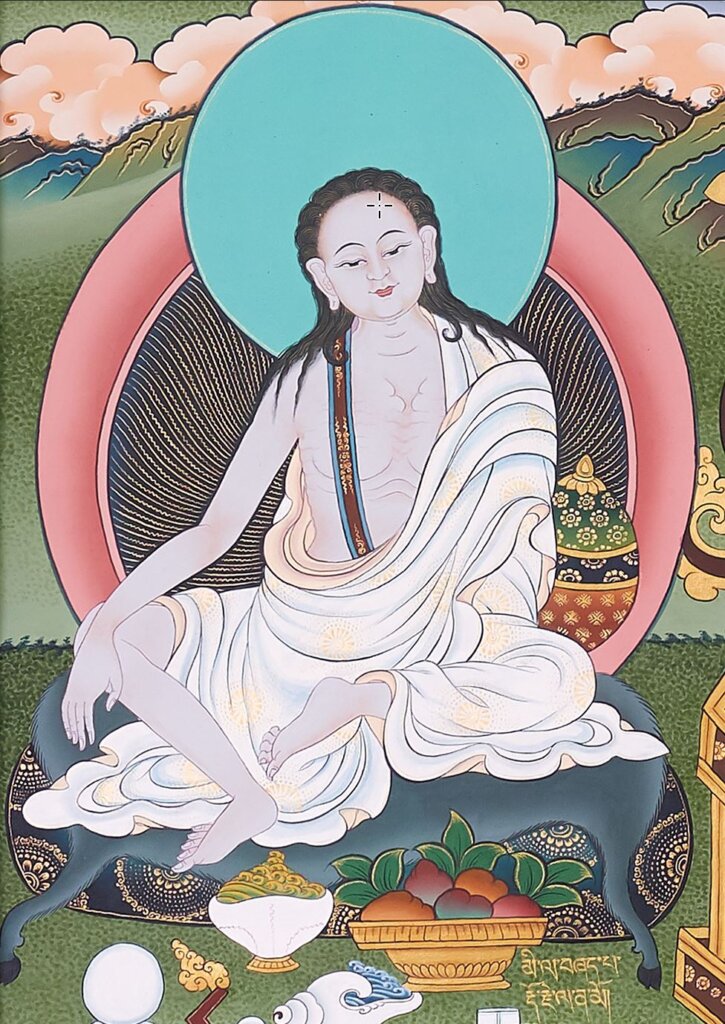
Milarepa's assertion that "the truth that rests on words is borrowed" invites us to reflect on the nature of knowledge and understanding. In a world saturated with information, we often find ourselves relying on the words of others to shape our perceptions of reality. This reliance can obscure our own direct experiences and insights, leading us to a borrowed understanding rather than an authentic one. The stakes are high: to navigate life with clarity and wisdom, we must discern between the truths that resonate within us and those that are merely echoes of external voices.
This quote serves as a poignant reminder of the limitations of language in conveying the depths of our inner experiences. Words, while powerful tools for communication, can also create barriers to genuine understanding. They can encapsulate ideas but often fail to capture the essence of direct-knowing, which is rooted in personal experience and insight. As we explore Milarepa's wisdom, we are called to seek a deeper connection with our own truths, moving beyond borrowed concepts to a more authentic engagement with the world.
The image / the metaphor
At its core, Milarepa's statement evokes a vivid image of truth as something that can be held, yet is inherently fragile and transient when expressed through language. The verb "rests" suggests a precarious balance, as if the truth is perched upon a surface that may not support its weight. This imagery invites us to consider the nature of our understanding—how often do we rely on the words of others, allowing them to shape our beliefs and perceptions? The notion of "borrowing" implies a lack of ownership, a temporary possession of ideas that may not resonate with our own lived experiences.
Diving deeper into the metaphor, we can see that the act of borrowing truth through words can lead to a disconnection from our authentic selves. When we rely solely on the words of others, we risk losing touch with our own inner wisdom and insights. This borrowed truth may serve as a stepping stone, but it can also become a crutch that prevents us from fully engaging with our own experiences. Milarepa's wisdom encourages us to seek a more profound understanding that transcends mere verbal expression, urging us to cultivate a direct-knowing that is rooted in our own being.
In the speaker's tradition
Milarepa, a revered figure in Tibetan Buddhism, embodies the principles of direct-knowing and experiential wisdom. His teachings emphasize the importance of personal insight over intellectual understanding, aligning with the Buddhist concepts of prajna (wisdom) and sunyata (emptiness). In this context, the idea of borrowed truth resonates with the notion of kenosis, or self-emptying, where one must let go of preconceived notions and attachments to truly understand the nature of reality. By recognizing the limitations of language and the borrowed truths it conveys, we can begin to cultivate a deeper connection with our own experiences and insights.
In the context of Milarepa's life, his journey from a life of suffering to one of profound realization illustrates the transformative power of direct-knowing. His songs, which are a testament to his spiritual journey, often reflect the tension between the limitations of words and the depth of experience. For instance, in the "Songs of Milarepa," he frequently emphasizes the importance of personal experience in understanding the nature of suffering and liberation. This emphasis on direct-knowing serves as a guiding principle for those seeking to navigate the complexities of existence, encouraging a shift from borrowed truths to authentic understanding.
Living the teaching
Consider a modern scenario where the teaching of Milarepa's quote can be applied: in the age of social media, individuals often find themselves inundated with opinions, beliefs, and information from countless sources. This constant flow of external voices can lead to a sense of confusion and disconnection from one's own values and truths. For example, a person may feel pressured to adopt certain beliefs or lifestyles based on what they see online, rather than reflecting on their own experiences and insights. In such moments, Milarepa's wisdom serves as a reminder to pause and discern what resonates within, encouraging a return to one's authentic self.
Another application of this teaching can be found in interpersonal relationships. In moments of conflict or misunderstanding, individuals may rely on borrowed phrases or clichés to express their feelings, often leading to further miscommunication. By embracing Milarepa's insight, one can strive for a more authentic expression of their emotions, seeking to articulate their experiences in a way that reflects their true self. This practice not only fosters deeper connections but also encourages a more profound understanding of oneself and others, moving beyond the limitations of borrowed language.
A reflection
As we contemplate Milarepa's assertion that "the truth that rests on words is borrowed," we are invited to explore the nature of our own understanding. Are we relying on borrowed truths, or are we engaging in a process of direct-knowing that reflects our authentic selves? In this spirit, consider this contemplative question: What truths do you hold that are uniquely yours, and how can you cultivate a deeper connection with them in your daily life?
