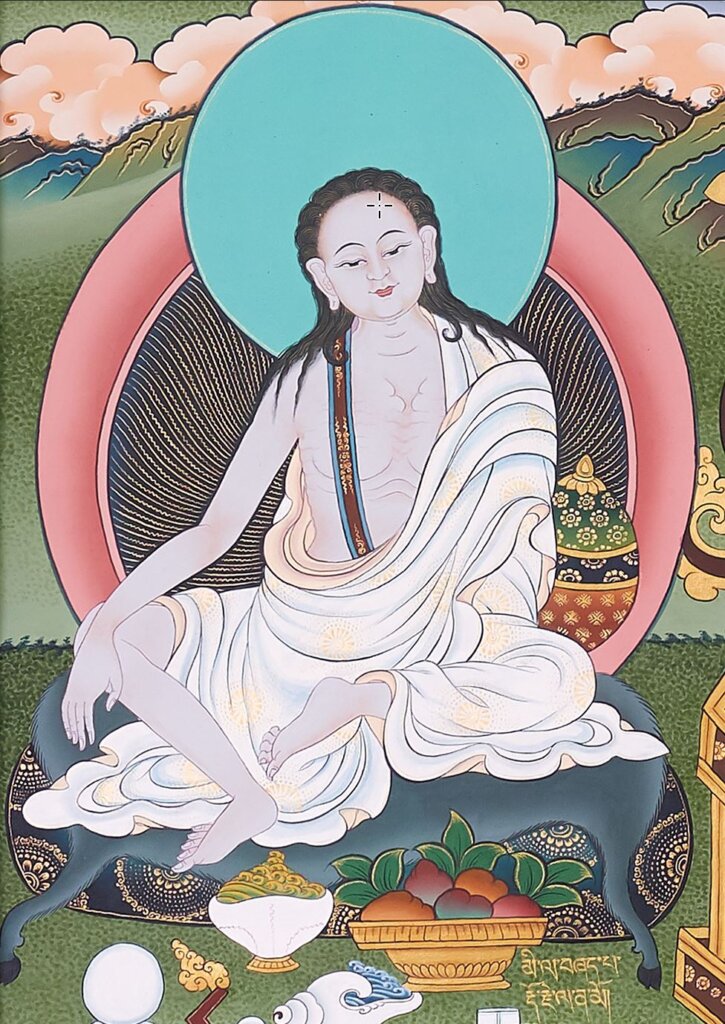
Milarepa's assertion, "There is no other way to enlightenment," serves as a profound reminder of the singularity and depth of the spiritual journey. In a world filled with distractions and myriad paths that promise quick fixes, this quote emphasizes the necessity of commitment and authenticity in the pursuit of true understanding. Enlightenment, in this context, is not merely an abstract concept but a lived experience that demands our full engagement and sincerity.
This statement invites us to reflect on the essence of our spiritual endeavors. It challenges us to consider what we are truly seeking and the lengths we are willing to go to achieve that state of realization. The path to enlightenment is often fraught with obstacles, yet it is precisely through navigating these challenges that we uncover the deeper truths of existence. Milarepa's words resonate as a call to embrace the journey, recognizing that there is no shortcut to the profound insights that await us.
The image / the metaphor
At its core, Milarepa's quote evokes a sense of urgency and clarity. The phrase "no other way" suggests a singular path, one that is both direct and uncompromising. The use of the word "enlightenment" conjures images of illumination, awakening, and the shedding of ignorance. This imagery is powerful, as it implies that enlightenment is not simply a destination but a transformative process that requires our full attention and dedication.
In the speaker's tradition
Milarepa, a revered figure in Tibetan Buddhism, embodies the essence of the spiritual path through his life and teachings. His journey from a life of suffering to one of enlightenment exemplifies the principles of dharma, the cosmic law and order that guides our actions and intentions. In this tradition, the concept of kenosis, or self-emptying, resonates deeply with Milarepa's message, as it emphasizes the necessity of relinquishing attachments and ego in order to attain true understanding.
Moreover, the notion of sunyata, or emptiness, plays a crucial role in this discourse. It suggests that enlightenment is not about acquiring knowledge or experiences but rather about recognizing the inherent emptiness of all phenomena. In the context of Milarepa's teachings, this understanding is vital; it encourages practitioners to look beyond the illusions of the self and the material world. Texts such as the "Songs of Milarepa" serve as a testament to this journey, illustrating the trials and tribulations that ultimately lead to profound insight and liberation.
Living the teaching
In our modern lives, the teaching of Milarepa can be applied to the pursuit of personal goals and aspirations. Consider a situation where an individual is striving for success in their career. The allure of shortcuts—such as networking or seeking favors—may seem tempting, yet true fulfillment comes from hard work, integrity, and a commitment to one's values. By embracing the notion that "there is no other way to enlightenment," this individual can cultivate patience and resilience, understanding that the journey itself is as valuable as the destination.
Another application of this teaching can be found in interpersonal relationships. When faced with conflict or misunderstanding, it is easy to seek quick resolutions or to avoid difficult conversations. However, true connection and understanding require vulnerability and honesty. By recognizing that there is no shortcut to genuine intimacy, individuals can engage more deeply with one another, fostering relationships built on trust and authenticity. In both scenarios, Milarepa's wisdom serves as a guiding light, encouraging us to embrace the challenges of the journey with courage and sincerity.
A reflection
As we contemplate Milarepa's profound assertion, we are invited to reflect on our own spiritual journeys. What are the shortcuts we may be tempted to take in our pursuit of understanding? How can we cultivate a deeper commitment to the path, embracing the challenges and lessons that arise along the way? In this moment of reflection, let us consider: What does it mean for you to walk the singular path to enlightenment in your own life?
