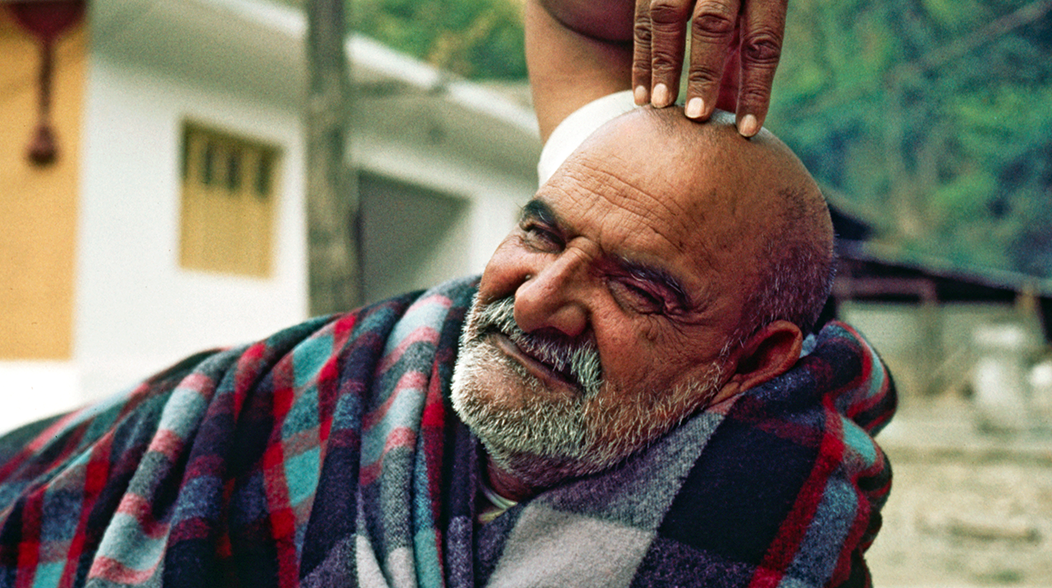
Neem Karoli Baba's profound statement, "In every face, see the Beloved," invites us to perceive the divine essence within each individual we encounter. This teaching challenges us to transcend our habitual judgments and biases, urging us to recognize the sacredness that resides in every human being. In a world often marked by division and misunderstanding, this perspective holds the potential to transform our relationships and interactions, fostering a deeper sense of connection and compassion.
At its core, this quote speaks to the heart of bhakti, the path of devotion, where love and reverence for the divine manifest in our treatment of others. By seeing the Beloved in every face, we are called to cultivate an attitude of love and acceptance, not only towards those we cherish but also towards strangers and adversaries. This radical inclusivity is not merely an ideal; it is a practice that can reshape our daily lives and the world around us.
The image / the metaphor
The imagery in Neem Karoli Baba's quote evokes a sense of intimacy and reverence. The word "Beloved" suggests a deep, affectionate connection, implying that each person we encounter carries a spark of the divine. The act of "seeing" is not passive; it requires an active engagement of the heart and mind, a willingness to look beyond superficial appearances and recognize the inherent worth of every individual. This perspective invites us to approach others with curiosity and openness, fostering a sense of unity in our shared humanity.
In the speaker's tradition
Neem Karoli Baba's teachings are rooted in the bhakti tradition, which emphasizes love and devotion as the primary means of connecting with the divine. Central to this path is the concept of dharma, or righteous living, which calls us to act with compassion and integrity in our interactions with others. The practice of seeing the Beloved in everyone aligns with the bhakti ideal of surrendering the ego, a process akin to kenosis, where one empties oneself to be filled with divine love. This perspective echoes the Buddhist notion of sunyata, or emptiness, which invites us to let go of our attachments and preconceived notions, allowing us to experience the world with fresh eyes.
In the context of bhakti literature, we can draw parallels to the teachings of saints like Kabir and Mirabai, who also emphasized the importance of seeing the divine in all beings. Their poetry often reflects a deep sense of love and devotion that transcends religious boundaries, inviting us to recognize the sacred in the mundane. This interconnectedness is beautifully captured in the Bhagavad Gita, where Krishna teaches that all beings are manifestations of the divine, urging us to see the unity in diversity.
Living the teaching
Consider a modern scenario where this teaching can be applied: a busy urban environment where people often rush past one another, absorbed in their own lives. In such a setting, the challenge is to pause and truly see the faces around us—not just as strangers but as reflections of the Beloved. This could mean offering a smile to a passerby, engaging in a brief conversation with a barista, or simply acknowledging the humanity in someone who seems troubled. Each small act of recognition can create ripples of connection, reminding us that we are all part of a larger tapestry of existence.
In a more personal context, this teaching can be particularly powerful in our relationships. Imagine a moment of conflict with a loved one, where frustration and misunderstandings cloud our perception. By consciously choosing to see the Beloved in that person, we can shift our perspective from blame to compassion. This practice encourages us to listen deeply, to empathize with their feelings, and to respond with love rather than defensiveness. In doing so, we not only honor the divine within them but also nurture the sacred bond that connects us.
A reflection
As we contemplate Neem Karoli Baba's invitation to see the Beloved in every face, we might ask ourselves: "How can I cultivate a deeper awareness of the divine presence in those I encounter daily?" This question invites us to reflect on our own biases and assumptions, challenging us to open our hearts and minds to the beauty and complexity of each individual. In this practice of seeing, we may discover not only the divine in others but also a deeper understanding of ourselves.