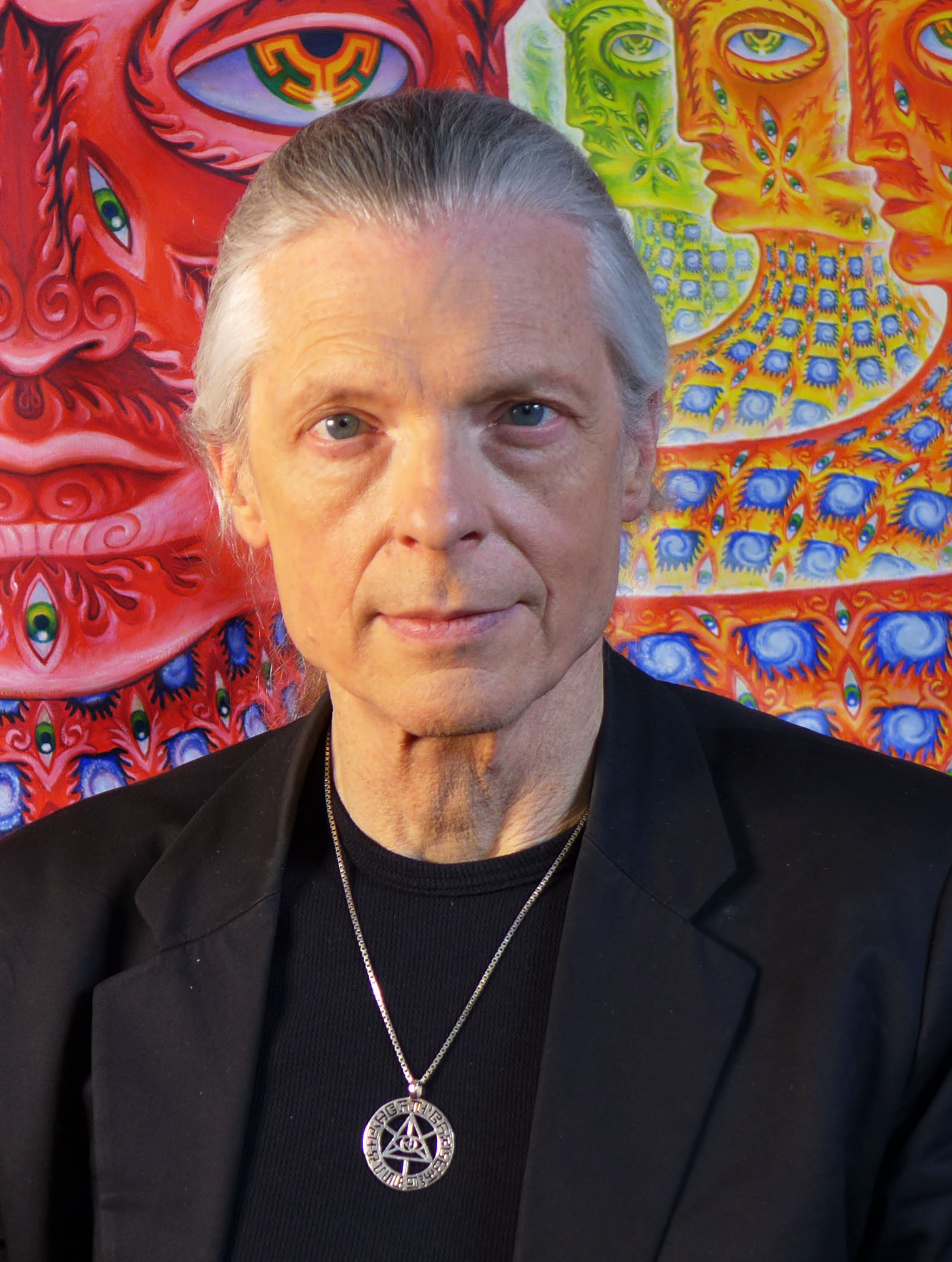
Visionary artist Alex Grey traces his artistic evolution from childhood drawings of death through sacred performance and psychedelic revelation to the creation of the Sacred Mirrors series—a philosophical framework integrating physical anatomy, subtle energy systems, and transcendental consciousness. Grey argues that sacred art functions as a "spiritual technology" capable of activating viewers, dissolving the illusion of separation, and reflecting our potential for enlightenment. His work fuses medical illustration, mystical experience, and collective ritual to demonstrate how creativity itself becomes a path to higher consciousness and planetary healing.
What Is the Trajectory of Human Consciousness in Art?
Grey opens his talk with a fundamental statement: art can chart the evolution of human consciousness from the physical to the mental to the transcendental. This is not metaphorical. The painting "Body, Mind, Spirit" literally depicts this ascending trajectory, and it establishes the organizing principle behind all his subsequent work. For Grey, consciousness itself evolves—not just individually through meditation or study, but collectively through the mirror of art and shared spiritual experience.
This framework emerges from his own journey. Beginning at age five, he drew skeletons filled with what he calls "magical thinking"—power animals, happy gravestones, and protective figures. By age ten, his skeleton depictions became "more archetypal, mythological," reflecting the Grim Reaper tradition. At seventeen, studying anatomy in art school, he rendered skeletons with scientific precision, naming every bone. The same subject—mortality—was filtered through three developmental stages: magical, mythic, and rational. This observation about his own artistic maturation becomes a model for understanding how consciousness itself can progress through stages of complexity and integration.
How Did Spiritual Crisis Become Artistic Awakening?
The transcript reveals a critical turning point: at age twenty, Grey fell into severe depression and performed a series of shocking ritual acts. He kept half his head shaved for six months, placed self-portraits in subway advertisement slots with leaflets inviting strangers to dinner or to "throw it down and step on my face." His final performance piece, "Brain Sack," involved eating spaghetti, cutting his hair onto the plate, placing a brain into the hair, ingesting ipecac to induce vomiting, and collecting all of it into a sack. He describes himself as "severely depressed" and prayed to "a god I did not believe existed" to show him a reason to continue living.
Within twenty-four hours, he was invited to a party where he took LSD for the first time. This experience radically reoriented his entire artistic mission. In his psychedelic vision, he encountered a "pearlescent spiraling tunnel" moving from darkness toward light, perceiving the light as God. He observed that "every conflict and polarity was resolved in this spiritual rebirth canal." Crucially, he saw that "gray brought the opposites together"—and this visual pun prompted him to change his surname from "Cowan" to "Grey." He was not simply healing from depression; he was receiving what he experienced as a genuine revelation about art's purpose: to reconcile polarities and opposites.
At the same party, he met Alison, who had also taken LSD. By the next day, "she was the love of my life." For thirty-eight years, he notes, they have remained married, studio mates, and creative collaborators. The spiritual breakthrough and romantic union were simultaneous—both happening within twenty-four hours of his prayer. This synchronicity shaped his entire philosophy: that prayer, consciousness, and creative partnership are woven together.
Why Did Grey Study Anatomy in a Morgue?
After his mystical awakening, Grey took a job in a morgue to study human anatomy directly. His reasoning was direct: "I wanted to make art about consciousness, and the body is the box that consciousness comes in. So I knew I'd have to understand it." He spent five years there, preparing bodies for dissection and sometimes performing dissection himself. He describes this as "an underworld experience" but one that helped him "appreciate the preciousness of body and soul."
This was not morbid curiosity or shock value. For Grey, intimate knowledge of the body's physical systems—bone, muscle, organ, vein—was spiritual practice. To represent consciousness accurately, he needed to understand its vessel. The morgue work was preparatory discipline, like the medical illustration training he had received at Harvard Medical School. It gave him both technical precision and reverent familiarity with mortality.
What Role Did Performance and Ritual Play in Grey's Practice?
Throughout the 1970s and 1980s, Grey and Alison engaged in elaborate performance rituals that functioned as what he calls "shock therapy to activate us and wake us up." These were not theatrical spectacles but embodied meditations on consciousness, mortality, and interconnectedness.
"Meditations on Mortality" featured Alison in white grease paint and Grey in black grease paint, both meditating on a skeleton. At the performance's conclusion, they "stepped outside of the circle of duality and sensuously merged our pigments and became gray"—literally enacting the principle of reconciling opposites through their own bodies.
"The Beast" involved Grey dressed in military uniform, stamping visitors' hands with the number 666 as they entered. He was "acknowledging what I felt to be the evil of the military industrial complex and acknowledging my complicity with a death machine." A nuclear crucifixion painting ten feet wide suggested that the same ignorance responsible for murdering saints would drive global self-destruction.
"Wasteland" depicted Mr. and Mrs. X arriving at a nuclear blast site, then feasting on money in hell. Grey and Alison literally "ate the money and drank the blood and vomited it up onto the table." He emphasizes that "some art is like shock therapy to activate us and wake us up to it"—a direct challenge to aesthetic comfort and complicity.
"Prayer Wheel" showed Grey and Alison in gold grease paint, tethered to a skeleton and carrying a baby doll, rotating sixty times around a prayer wheel while chanting the Tibetan Buddhist mantra "Om Mani Padme Hung." The sculpture piece "Living Cross" featured the couple lying motionless in a cross of apples and roses, staring at the angel of death while Alison nursed their daughter Xena.
"Heart Net," displayed at the American Visionary Art Museum for a year, invited visitors to write prayers for the earth. Ten thousand prayers accumulated on the web-like installation, creating what Grey calls "a beautiful outpouring from the community and a new vision of the world." This marked a shift from ritual's private, initiated experience toward collective participation and planetary consciousness.
How Did the Sacred Mirrors Series Emerge?
The Sacred Mirrors series grew directly from a performance called "Life Energy." Grey and Alison gathered with a group of people to practice exercises aimed at activating their life force. Grey created two charts for this work: one mapping the nervous system and another showing "a kind of subtle energy map." Alison, observing how moved people were by the experience, suggested he create an entire series based on this concept. She also named the series "Sacred Mirrors."
The finished Sacred Mirrors consist of twenty-one paintings, each rendered within frames that Grey and Alison hand-sculpted and cast in their basement in 1985. The series provides what he calls "a philosophical framework for the biological and technological evolution of humanity and ascending toward God consciousness."
When viewers engage with each painting, they are invited to "meditate on it and feel the system inside." The work fuses three systems of representation: physical anatomy (visible to modern medicine), subtle energy anatomy (drawn from Eastern philosophical and acupuncture traditions), and transcendental consciousness (representing dissolution of individual identity into light).
The psychic energy paintings show "the x-ray anatomy fused with the acupuncture meridians and points, the chakras, the auras, and all floating in a kind of pranic psycho-energetic soup." The spiritual energy system paintings depict "the progressive dissolving of the physical identity into the light body." Finally, the "Universal Mind Lattice" was inspired by an experience Grey and Alison shared on June 3rd, 1976, after he took a massive dose of LSD.
In that vision, he perceived "an infinite vista of toroidal fountains and drains of light" where "every being in the universe was one of these balls of light, kind of like a cell in the body of God." He realized "it was all made of love. The light was love and it connected us all." This experience of cosmic unity became the animating vision behind the entire series.
What Is the Relationship Between Art and Planetary Consciousness?
Grey's trajectory moves from individual spiritual revelation toward collective planetary healing. Early works confronted the viewer with mortality, complicity, and shadow. Later works—especially those involving community participation—aimed to activate a sense of shared divinity and interconnectedness.
"World Spirit," an event in the Bay Area involving about a thousand people, brought together musicians and performers "to create an experience of unity and healing." The "Heart Net" invited written prayers. These works function as what Grey calls "spiritual technologies"—art forms designed not merely to represent consciousness but to catalyze its evolution in the viewer and the collective.
Grey emphasizes that his work is informed by "different world wisdom traditions" and envisions a "hopeful future where there's a planetary healing" and a recognition that we are each "an anthropocosmic node of awareness." Sacred art, in his view, is not decoration or entertainment but a method for dissolving the illusion of separation and revealing our fundamental unity.
How Does Integral Philosophy Deepen the Vision?
Grey references Ken Wilber's integral map—a four-quadrant framework that organizes consciousness and reality into upper left (individual interior), upper right (individual exterior), lower left (collective interior), and lower right (collective exterior). Sacred art, in this view, activates all four quadrants simultaneously. It engages individual experience (I), individual physiology (it), cultural meaning (we), and systemic transformation (its).
When viewers encounter a Sacred Mirror painting, they are not just looking at an image; they are engaging their own subtle body awareness, relating to the depicted figure as a sacred mirror of their own potential, recognizing cultural and spiritual traditions encoded in the imagery, and participating in a collective field of healing intention. The artwork becomes "a battery of consciousness" that radiates beyond the gallery wall.
What Is the Ultimate Vision of Visionary Art?
Grey describes the final vision with both specificity and mystery. Art represents "the echo of the divine in matter." It is the mechanism by which humans recognize themselves as conscious nodes within a cosmic body. At the moment of death, according to his vision, "an ectoplasmic wisp of the soul ascends to the Oversoul"—the unified field of consciousness that underlies all existence.
This is not naive spiritualism but a framework grounded in his actual artistic practice: years of anatomical study, direct psychedelic exploration, collaborative ritual, and engagement with world wisdom traditions. Visionary art, he argues, is not escape from the body or the world. Rather, it is the highest use of human creativity: to wake others up, to heal planetary wounds, and to remind us of our own divinity—not as fantasy but as the deepest truth of existence.
Where to Go From Here
Grey's work invites multiple directions of exploration. Interested in the integration of art and spiritual practice? Research the intersection of aesthetics and contemplative traditions, or visit collections of visionary art like the American Visionary Art Museum. Curious about the mapping of consciousness through anatomy and energy systems? Study the chakra system, acupuncture meridians, and contemporary neuroscience's emerging models of consciousness. Drawn to sacred performance and ritual as spiritual technology? Investigate ceremonial arts, contemporary sacred theater, and collective healing practices. Interested in how consciousness might be understood as an evolutionary phenomenon? Explore the work of Ken Wilber on integral consciousness, Sri Aurobindo on spiritual evolution, or contemporary systems thinking applied to collective consciousness. Consider creating your own art or ritual that explores your relationship to mortality, interconnectedness, and the sacred—the core themes that have driven one of contemporary spirituality's most visually powerful practitioners.


