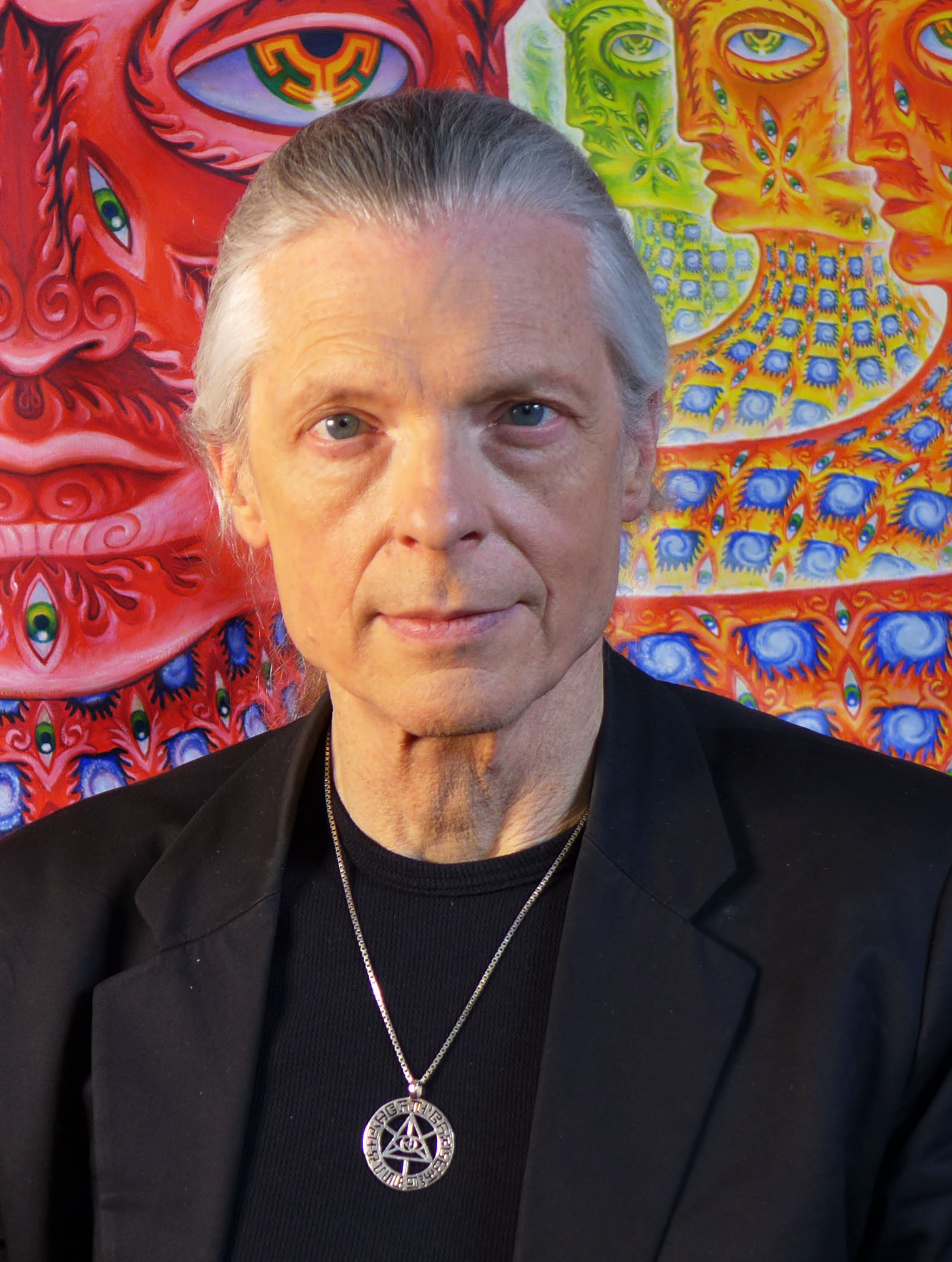
Visual artist Alex Grey describes how his first DMT experience synchronized with a painting he had dreamed about days earlier. During the DMT state, he became the subject of that painting—a figure of light ascending toward greater light. The experience revealed geometric forms, jewel-like structures, and an overwhelming sense of ecstatic beauty that informed his artistic practice for years. Grey uses these visions as source material for paintings and large-scale computer animations, including work featured in museum installations and music videos, exploring how to translate inner visionary experience into shared cultural expression.
In the days before his first DMT encounter, Grey had a vivid dream in which he was working on a painting called "Transfiguration." In the dream, a figure stood with arms raised, hovering over the earth, enveloped in a ball of light. The composition struck him as simple and striking enough to record. When Grey took DMT a few days later, he recognized an immediate synchronization with the dream image.
As he inhaled the substance, his own body became the body in the painting. Grey describes a unique transformation: his form "started out kind of solid at the feet and then grew increasingly more translucent until I felt like I popped into the bright world." This dissolution took about 30 seconds and transported him fully into a visionary realm. The dream and the experience had aligned—he had become the subject of the painting he'd envisioned.
From within the painting itself, Grey found himself holding his arms upward, experiencing his own body as a "spirit grid of light." He was looking inward at "turning jewel like forms" arranged within a wireframe structure of his own being. A powerful upward pull drew him toward "greater greater light," and surrounding him was what he calls a "hyper mind sphere"—filled with "faceted iridescent geometry" that shifted continuously.
The overall sensation was one of overwhelming beauty combined with what he describes as an "ecstatic uh melting feeling." This wasn't merely a passive observation; Grey was receiving specific details about the painting from within the experience itself. As he notes, "I was within within the painting and that had never happened before really." The vision became an active collaboration between his dream-consciousness and the DMT state, providing him with direct information about how to realize the artwork.
The DMT journey "carried me through like a year" of painting work. Rather than being a one-off mystical encounter, Grey treated it as a generative source—a wellspring of specific visual and conceptual material. The experience was "really informative, really helpful," grounding his subsequent artistic decisions in a direct encounter with the states of consciousness he was trying to represent.
This approach reflects a core aspect of Grey's method: visionary experiences are not separate from artistic production but integrated into it. The DMT state provided both the aesthetic details (the geometry, the light quality, the sensation of ascension) and the conceptual framework (the figure as a spirit grid, the sense of inner illumination).
During the same DMT journey, Grey had another vision he titled "Collective Vision." In this image, faces were arranged in a specific configuration—linked together, with eyes that formed a continuous pattern ascending into a dome. "We had a continuous kind of um eyes that went up into a dome of eyes. And so this was heads linked together and eyes all uh beautifully arranged geometrically in a in a inside dome."
This painting did not remain confined to the gallery wall. The vision later became a computer graphics installation used at the Museum of Natural History in a program called "Sonic Vision," for which musician Moby provided DJ work. The installation reimagined the planetarium experience—instead of gazing outward at outer space, visitors looked inward at inner space, with the "Collective Vision" artwork creating an immersive journey through interconnected consciousness.
Grey reflects on this translation: "It's interesting how these um DMT experiences then are getting translated into a broader culture. I'm fascinated about sharing these visions in the uh uh with computer graphics." The work demonstrates his commitment to taking private visionary states and rendering them accessible to wider audiences through technological mediation.
In Brazil, working with ayahuasca (Iawasa), Grey experienced a different vision that eventually became the painting "Net of Being." Unlike the human figures of earlier works, this vision presented "godlike heads" with four faces each, arranged as columns in a sacred space. As Grey describes it: "I was kind of flying through this uh space of these interconnected godheads. And um it was really beautiful and very jewelike."
The heads were not simple forms but complex structures filled with grids through which entire galaxies appeared to spin. The faces themselves resembled flames, luminous and flowing. Most importantly, the vision conveyed a sense of infinity: "they went on infinitely. It was a infinite consciousness, an infinite interconnectedness, a sense of a continuum of being that really was very highly networked, a mesh of being."
The experience expanded Grey's sense of individual identity outward: "identity with that um spread my consciousness and being out to a vast uh expanse in the you know as as vast as could be." He experienced himself as part of a "consciousness grid that was completely co-extensive with all space"—a dissolution of the boundary between self and cosmos.
Grey identifies a fundamental artistic problem: "you can have these visions and anybody I think can have these uh kinds of visions but then like how do you translate them into something that you can share with people it's very challenging." The gap between inner experience and outer representation is not trivial. One person's transcendent vision must be encoded into a form—paint, animation, sound—that allows others to approach the same territory.
This challenge has occupied Grey for years. The paintings themselves are not documentation but interpretation—an attempt to capture the quality, the geometry, the emotional and spiritual texture of the inner state. Computer animation offers a new dimension: it can add movement, scale, and immersion. Rather than viewing a static image, viewers can journey through the Net of Being, following the path the artist himself traveled.
Grey's work drew the attention of Adam Jones, the visual artist and guitarist for the band Tool. Jones "recognized the beauty and oddness of this space in the net of being." Tool used the Net of Being imagery in the CD package of their album "10,000 days" and commissioned a fully computer-animated fly-through journey for the music video "Vicarious."
This collaboration represents another step in Grey's project to bring DMT visions into "a fully dimensionalized, you know, computer animated kind of Video." The music video format and Tool's large audience extended the reach of visionary material into mainstream culture. The viewer is no longer standing before a painting in a gallery or museum; they are traveling through animated geometry synchronized with music, experiencing a constructed approximation of the artist's inner journey.
Grey's body of work demonstrates that visionary experience need not remain private or ineffable. Through sustained artistic practice—painting, animation, collaboration with musicians and institutions—direct encounters with non-ordinary states of consciousness can be translated into shared cultural forms. The art is not claiming to fully capture the original experience (which would be impossible) but rather to create a bridge: a structured aesthetic and conceptual pathway that allows others to begin approaching the same territory.
The progression from painting to museum installation to music video also shows how technology extends the artist's ability to render inner space. Where a painting is static and requires the viewer to project movement and depth onto the canvas, animation can provide the movement itself—the sense of flying through geometric space, of ascending toward greater light, of encountering infinite interconnectedness as a navigable environment.
If you're interested in exploring visionary art and its sources, consider examining Grey's painted works in reproduction or in person. Visit museum installations that use immersive media to convey altered states of consciousness. If you use music as a gateway to non-ordinary experience, seeking out Tool's "Vicarious" video in high quality will give you direct access to the Net of Being animation. For those interested in the relationship between psychedelic experience and artistic practice, Grey's approach offers a model: treat visions not as final spiritual states but as raw material for sustained creative work. The translation from inner to outer is the real art.


