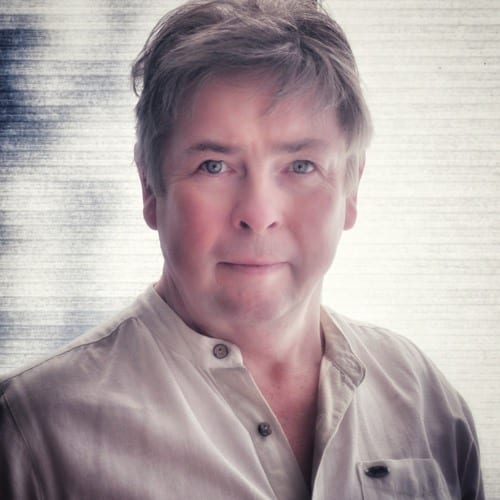
Tom Evans is not a singer-songwriter, and his catalog is not built on songs in the conventional sense. He works as a composer and sound designer, and the albums on his Spotify profile are ambient pieces made with technology: sustained tones, layered synthesis, slow movement, and a lot of space. There is no percussive urgency here. Titles point the same way. "Largo" borrows a musical term for a slow, dignified pace, and the albums Stygian (July 2022, nine tracks) and Origins (August 2025, fifteen tracks) are framed as full-length listening experiences rather than loose collections of singles.
The sources do not say whether voice is a central instrument. His single "Chant For The Unholy" (2022) hints at a vocal or quasi-vocal dimension, but whether that is his own voice, a guest, or processed sound is not specified, so I won't guess. What can be said is that his speaking voice matters elsewhere in his work, since he is first a meditation guide, and the music is composed as part of that practice. He describes it as a door to higher perception, not as background accompaniment.
This is not bhakti, kirtan, mantra, or folk music, and nothing in his materials claims otherwise. His bio calls him a meditation guide, mystic engineer, storyteller, and contemporary alchemist, and it names no guru, teacher, or lineage. His own sources describe the work as syncretic and post-traditional. The nearest thing to a framework is Western esoteric: he curates The Adytum, described as a contemporary school of practical alchemy, and his Path to Overstanding includes 22 meditations keyed to the Major Arcana of the Tarot, used as waypoints for exploring consciousness rather than for divination.
He trained as an engineer and says he researches ideas about time empirically, looking for ways to put them to practical use. That temperament shapes the music. It is built the way an engineer might build an instrument for attention: deliberately, with a purpose.
Evans's distinctive move is refusing to separate his practices. In many meditation catalogs the breathing instruction, the philosophy, and the music live in different boxes. For him, meditation, storytelling, consciousness research, and technology are interconnected tools. The clearest example is the Path to Overstanding, a body of roughly 100 audio modules that pairs 22 Major Arcana meditations with 22 ambient compositions. The music is not a soundtrack added afterward; it is one half of the curriculum.
His other signature is intent. He aims to awaken nascent aspects of consciousness and enhance creativity, with what he calls calm, clarity, and fun, rather than to soothe or to resolve suffering. The albums are composed as guided perceptual experiences, and that purpose shapes how they are paced and layered.
The materials supplied name no individual collaborators, producers, or featured vocalists, and I won't invent any. What they do show is context: his tracks appear on compilations titled Electronic Mood Board, Touched by Tech, and Abbey Road Masters: Hybrid Score. Those placements put him alongside other ambient and electronic composers, even though the specific names aren't given. His creative partnerships on the page are largely with his own projects, including New Reality Journeys, where he is CIEIO, and The Adytum.
Start with a track from Origins on Spotify, then watch one short guided meditation on his YouTube channel (@TomEvans) and see whether his voice and aesthetic suit you. If you want structure, the Path to Overstanding is designed for sequential listening, not random sampling. Stygian is the natural second stop, and listening from Stygian to Origins shows how his sound developed over three years.
Some things may surprise you. Expect active listening: the music is meant to be attended to, and it won't fade politely behind a spa treatment. Expect an intellectual register too. His teaching respects the listener's mind and imagination instead of asking them to be set aside. If you read his novel Soulwave, a post-dystopian cyberpunk story built on a universe of soulwaves, you will see where the sonic imagination comes from: science fiction, not a monastery. And if you want a single coherent system or a conventional relaxation soundtrack, this may not be the right fit. His own sources describe the work as exploration, not fixed doctrine.
Much conscious music draws on devotional forms: chanting, call-and-response, acoustic instruments, a named lineage. Evans stands apart from that. His place is in the ambient, new-age, and conscious-electronic territory, closer to sound-journey and guided-meditation practice than to devotional singing. His roughly 48,200 Spotify followers suggest a real audience, and his compilation appearances place him in a contemporary electronic and hybrid-score conversation.
What separates him within that field is the engineering mindset and the Western esoteric frame. Where many peers lean on ancient authority, he leans on experiment, story, and technology, including AI as a possible aid to awakening. That makes him a good match for listeners who read science fiction, like philosophy, and want music that sharpens attention rather than dissolving it.