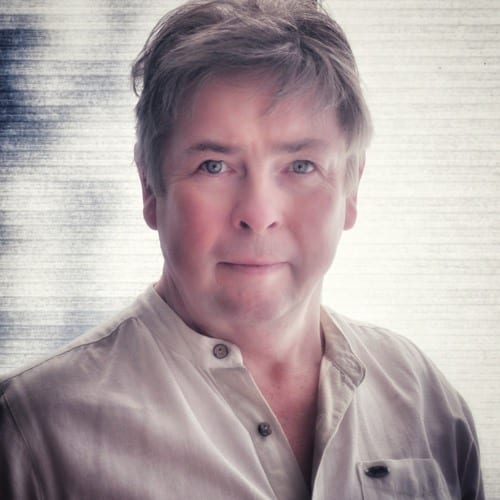
Touched by Tech, Vol.09 arrived on December 26, 2025, as a 16-track compilation. It is not a Tom Evans album in the strict sense. It is a gathering in which his work appears among other contributions, and it is best approached with that in mind. The sections below say what can honestly be said about it, and where the available facts stop, they stop.
Evans describes himself as a meditation guide, mystic engineer and storyteller. His main album statements are Stygian (2022) and Origins (August 2025), both conceived as guided perceptual experiences rather than background listening. Touched by Tech, Vol.09 comes months after Origins and belongs to a different category: the compilation appearance. Evans has appeared on other compilations too, including Electronic Mood Board and Abbey Road Masters: Hybrid Score. Seen this way, Vol.09 is less a new chapter than a sidelong view of his practice, showing how his sound holds up beside other contemporary electronic and ambient work.
The title also suits him. Evans trained as an engineer and writes regularly about how technology and AI might serve awakening rather than obstruct it. A series called Touched by Tech is a natural home for that outlook.
I can't responsibly give a track-by-track account of instrumentation here, so this section describes his general sound as documented. Evans works primarily as a composer and sound designer, not a vocalist. His music is built for active listening: sustained tones, layered synthesis, space and slow pacing rather than beats or rhythmic urgency. He treats composed sound as a door to higher perception.
On a sixteen-track compilation, expect that sensibility to meet other styles. Contrasts in texture and tempo between contributors are part of the experience. His contribution should read as the contemplative, unhurried element, in keeping with the calm, clarity and fun he says he aims for in his teaching. The tone is deliberately unsentimental. It is not spa music.
I'm not naming specific tracks. The information available to me does not identify which of the sixteen are Evans's or what they are called, and guessing would mislead you. The practical approach is to open the album on Spotify, check the credits and find his contribution yourself. Once you've found it, listen for three things:
- Patience of pacing. Does the piece let a tone unfold rather than pushing toward a hook?
- Layering. Does the texture deepen on repeat listening?
- Placement. How does it change the mood of the tracks on either side of it?
Those questions will tell you more than a borrowed description could.
Evans does not claim a single lineage. His work is syncretic and post-traditional. He curates The Adytum, described as a contemporary school of practical alchemy, and his Path to Overstanding curriculum pairs 22 meditations keyed to the Major Arcana with 22 ambient compositions. So the music is better understood as part of a Western esoteric and consciousness-research current, with a strong technological bent, than as bhakti or kirtan. There is no devotional chanting tradition to place him in. The closest comparison is contemporary ambient and electronic composition, where sound is made to alter attention.
This compilation suits listeners who already like electronic and ambient music and are curious about Evans without wanting to commit to a full album. It also suits people who read science fiction, enjoy philosophy and consciousness research, and want music that engages thinking rather than switching it off. It will probably disappoint anyone looking for conventional relaxation or stress reduction, or for devotional singing. It also isn't the ideal first stop for newcomers; Origins is a more representative introduction to him as a composer.
A good life moment for it is a curious, open one: a break between projects, an evening when you want to explore new sounds, or the days after a year ends and the next begins.
Use headphones, and give it an unbroken sitting in the evening, with the screen dimmed and nothing else asking for your attention. Play the album in sequence once without skipping, and let the contrasts between contributors register. Then locate Evans's piece and replay it alone, with eyes closed, treating it as he intends his music to be treated: as an experience to enter rather than a soundtrack to something else.
If it resonates, follow it with Origins and then Stygian, where you can hear his compositional voice at full length and in his own context.